Why Higher Gold Prices Could Transform Parker Schnabel’s $15 Million Dominion Creek Bet
Why Higher Gold Prices Could Transform Parker Schnabel’s $15 Million Dominion Creek Bet
Parker Schnabel’s $15 million investment in Dominion Creek was never going to be judged by one cleanup. It was a long-term wager on ground, access, equipment, and the ability of his crew to turn a large property into a repeatable mining system. Season 15 showed why that distinction matters. Even when a claim contains gold, the operation can struggle if frozen pay, breakdowns, stripping depth, or plant logistics prevent the team from reaching it efficiently.
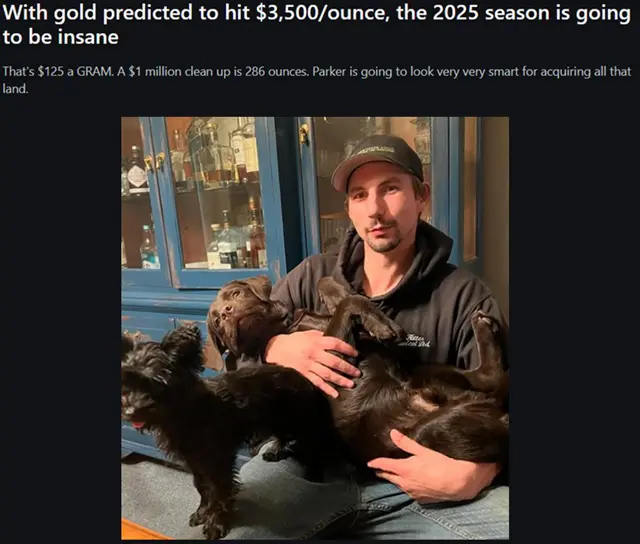
That difficult start led some Gold Rush viewers to question whether Parker could recover the purchase price in a reasonable period. Then another variable entered the conversation: the value of gold. Fans began discussing a prediction that the metal could reach $3,500 per ounce. At that price, every ounce recovered would generate more gross revenue than it would at a lower market price, making previously marginal ground appear more attractive.
The theory is directionally sound, but it is not the same as proof that Parker will earn a massive profit. A higher gold price can improve the value of production. It cannot automatically fix equipment, remove overburden, thaw frozen ground, reduce fuel use, or repay a $15 million acquisition. Dominion Creek’s outcome still depends on how many ounces Parker can recover and what it costs him to recover them.
The Dominion Creek Gamble Was About More Than One Season
Parker made the purchase at age 28 and reportedly committed his savings to secure part of the Klondike gold district. The region has a mining history reaching back to 1898, and the supplied account describes Dominion Creek as placer-gold ground. That kind of operation requires the crew to locate and process gold-bearing material distributed through sediment rather than extract a single visible vein.
Buying ground changes the financial structure of a mining business. A lessee may pay royalties or operate under terms established by a claim owner. An owner commits capital upfront but gains greater control over planning and future access. If the property performs, ownership can support years of production. If it disappoints, the miner carries the cost of the land along with the cost of every failed cut.




That is why viewers who expected Parker to recover $15 million immediately may have been applying the wrong timetable. A large property can be valuable even when the first season is inefficient, provided the work produces information that improves future seasons. Test results, stripping depths, road placement, thawing strategy, and equipment requirements all become part of the asset’s operating knowledge.
However, “long term” cannot become an excuse for unlimited losses. Parker still needs the property to generate enough gold to fund payroll, fuel, repairs, reclamation, and continued development. The investment only looks intelligent if the ground eventually produces returns greater than the total capital and operating cost.

How a Higher Gold Price Changes the Equation
The simplest effect is on gross revenue. If an operation recovers 1,000 ounces, a price of $3,500 per ounce would imply $3.5 million in gross metal value before deductions and expenses. The same physical production becomes more valuable without the crew moving an additional yard of dirt.
That difference can change decisions at the edge of profitability. Ground that was too expensive to strip at a lower price may become workable. Old tailings may deserve another look if improved recovery methods can capture gold that earlier miners left behind. Cuts with lower grades may remain viable longer because each recovered ounce contributes more revenue.
Fans raised precisely those possibilities. Some asked whether higher prices would make it worthwhile to reprocess old-timer tailings. Others wondered whether Parker should clean up marginal areas, concentrate on the best ground, or attempt both. Those are strategic questions, not simple predictions.
A higher price gives management more options, but the best option depends on capacity. Parker cannot process every promising area at once. Plants have throughput limits, crews have finite hours, and equipment must be allocated between stripping, hauling, maintenance, and reclamation. Choosing lower-grade ground can also delay access to richer material.
What the $3,500 Fan Forecast Does Not Confirm
The figure discussed by fans was a prediction, not a guaranteed market outcome in the supplied article. It should therefore be treated as a scenario. Parker’s business cannot be evaluated as though that price has already been secured for every future ounce.
Gold prices can move while a mining season is underway. Even when the market rises, the price a producer effectively realizes may differ because of timing, refining arrangements, fees, or sales decisions. The television value attached to a cleanup is useful for illustrating scale, but it does not reveal the exact cash ultimately received by the operation.
The forecast also says nothing about production volume. If breakdowns or frozen ground sharply reduce recovered ounces, a higher price may only partially offset the lost output. Price and volume work together. A strong price on a small cleanup can still produce less revenue than a moderate price on a large, efficient season.
Revenue Is Not Profit
This is the most important distinction in the entire debate. Fans often multiply ounces by a quoted gold price and call the result “earnings.” That calculation estimates gross metal value. Profit is what remains after the operation pays its costs.
- Ground preparation: Overburden must be stripped before the crew reaches paydirt.
- Equipment: Excavators, dozers, rock trucks, pumps, and wash plants require purchase, lease, repair, and maintenance spending.
- Fuel: Heavy machinery can consume significant fuel throughout a long operating day.
- Labor: Skilled operators, mechanics, supervisors, and support staff must be paid.
- Infrastructure: Roads, pads, water systems, camps, and power arrangements support production.
- Property obligations: Acquisition costs, financing, royalties where applicable, and reclamation responsibilities affect the final return.
A higher gold price can expand the margin between revenue and cost, but only if costs remain controlled. If the operation must spend heavily to repair equipment or move enormous quantities of barren material, much of the price benefit can disappear.
Why Equipment Trouble Matters So Much
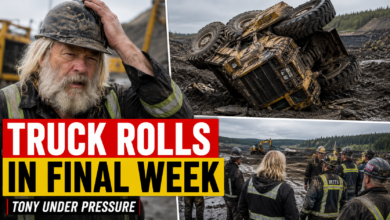
Season 15 placed repeated emphasis on machinery setbacks. Equipment problems hurt twice. The direct repair costs money, and the downtime prevents the crew from producing while fixed expenses continue. A wash plant that is not running cannot recover gold, even if the ground beneath the cut is excellent and the market price is favorable.
Breakdowns can also disrupt the sequence of an entire mine. If a key excavator fails, trucks may wait for material. If hauling stops, the plant may run empty. If the plant fails, stockpiled pay grows while the crew loses processing days. One machine can become the constraint that limits the value of every other asset on site.
This is why Parker’s recent excavating posts may be more important than lifestyle observations about courtside seats or travel. The business question is whether his team is opening ground and building a more reliable production system. Personal spending visible on social media does not reveal the profitability of Dominion Creek.
Frozen Pay and the Value of Learning
One fan argued that the difficult season may position Parker for a stronger following year because he now understands how deep to strip and how to avoid frozen pay. That interpretation identifies a genuine form of operational value: information.
When a crew learns the depth, character, and temperature conditions of the ground, it can redesign the sequence of future work. Stripping can begin earlier. Thawing can be planned. Roads can be placed where they reduce hauling time. Equipment can be matched more accurately to the volume of material.
Learning does not repay the investment by itself, but it can reduce the cost of future mistakes. Dominion Creek’s first difficult season may therefore be both a financial setback and a mapping exercise for later production. The balance between those two outcomes will only become clear when subsequent results show whether the crew applied what it learned.
Could Old Tailings Become Worth Processing?
Fans suggested that rising prices could make old tailings attractive. The logic is straightforward. Earlier miners may have left gold behind because their equipment, recovery methods, or economics made further processing unattractive. If modern equipment captures a higher percentage and the price per ounce rises, material once treated as waste can become potential feed.
But tailings are not automatically profitable. They must contain enough recoverable gold, be accessible, and pass through the plant without excessive preparation. Testing is essential. Processing low-grade material because the gold price is high can still lose money if the cost per yard exceeds the recovered value.
For Parker, tailings could represent a way to generate feed while larger cuts are being prepared, but that would depend on the specific ground and plant setup. The fan discussion identifies an opportunity, not a confirmed plan.
High-Grading Versus Building a Long-Term Mine
Another viewer asked whether the team should focus only on the richest areas. High-grading can improve short-term ounces by prioritizing material expected to contain more gold. That may help cash flow after an expensive purchase or a difficult start.
The drawback is that a mine cannot always chase only its best ground without affecting the broader plan. Rich zones may sit beneath overburden that must be removed systematically. Skipping lower-grade sections can create awkward pits, longer hauls, or future reclamation problems. A property owner must think beyond one televised weigh-in.
Parker’s challenge is to balance immediate production with development. He needs enough gold now to support the operation, while preparing Dominion Creek to run efficiently over multiple seasons. A higher price can ease that tension, but it does not eliminate the need for disciplined sequencing.
Why Fans Say Parker Could Look Smart
The positive argument is not merely that gold might become more expensive. It is that Parker secured a large property before a potential rise in value made productive ground even more desirable. If Dominion Creek contains recoverable reserves and his team improves efficiency, ownership could give him exposure to both higher production and higher prices.
His age also shapes the perception. At 28, he made a commitment large enough to threaten the savings he had accumulated. If the investment succeeds, viewers will see it as evidence that he accepted short-term pressure to control a long-term asset. If it fails, the same decision will look overly aggressive.
That is the nature of a major capital bet. The intelligence of the decision cannot be measured solely by confidence at the time of purchase. It must be measured by future cash generated relative to everything spent.
The Todd Hoffman Jokes Miss the Main Point
Some commenters used the discussion to mock Todd Hoffman, suggesting that even higher prices would not guarantee his success. The joke unintentionally reinforces the correct economic lesson: market conditions cannot rescue an inefficient operation indefinitely.
Two miners can sell gold at the same price and produce very different results. The operator who controls stripping costs, minimizes downtime, tests ground carefully, and keeps the plant supplied will retain more value. The operator who repeatedly changes plans or suffers avoidable losses may struggle even during a favorable market.
Parker’s reputation for detailed planning is one reason fans believe he may benefit more than others from a higher-price environment. Reputation, however, is not a substitute for Dominion Creek’s actual production data.
What Parker’s Lifestyle Posts Do—and Do Not—Show
Fans have pointed to courtside seats at a Los Angeles Lakers game and travel to attractive beaches as signs that Parker is financially comfortable. Those images may show personal success, but they do not disclose the financial performance of a specific claim.
A business owner can have accumulated wealth while a new project loses money. A project can also require years of reinvestment before distributing profit. Social-media appearances therefore should not be used as evidence that the $15 million purchase has already paid for itself.
The more relevant updates are operational: excavation, crew activity, opened ground, plant reliability, and the volume of gold recovered. Those indicators connect directly to whether Dominion Creek is developing into the mine Parker intended to build.
Three Tests That Will Decide the Investment
The first test is recoverable volume. Dominion Creek must contain enough gold-bearing material to support sustained production. The second is cost per recovered ounce. Even abundant gold can be uneconomic if it lies beneath too much overburden or requires excessive thawing and hauling. The third is execution. Parker’s team must keep equipment working and apply what it learned from the difficult season.
Gold price influences all three tests without replacing them. A higher price increases the value of each recovered ounce and allows a larger cost margin. It does not create ounces that are not present or move dirt that the crew cannot reach.
The Most Accurate Outlook
Fans are right that a move toward $3,500 per ounce could materially improve Parker’s revenue potential. They are also right that higher prices can make tailings and lower-grade ground more attractive. Where the discussion becomes too confident is in assuming that those effects guarantee a massive profit.
Dominion Creek remains a production challenge as much as a market opportunity. Parker must convert ownership into reliable throughput, recover enough ounces, and keep total spending below the value of the gold. The setbacks shown during the season demonstrate how difficult that process can be.
If the team uses its new knowledge to begin future seasons faster, avoids frozen pay, and reduces equipment downtime, the $15 million purchase may look increasingly strategic. If operational problems continue, even a strong gold price may only soften the losses.
The real story is therefore more compelling than a simple prediction of “massive earnings.” Parker made a high-risk purchase that gives him substantial upside, but the market will reward him only if the mine performs. Higher gold prices can change the mathematics. His crew still has to change the ground into gold.