TYSON LEE REFUSES TO HELP MITCH AS PARKER’S CREW FRACTURES UNDER EQUIPMENT PRESSURE
TYSON LEE REFUSES TO HELP MITCH AS PARKER’S CREW FRACTURES UNDER EQUIPMENT PRESSURE
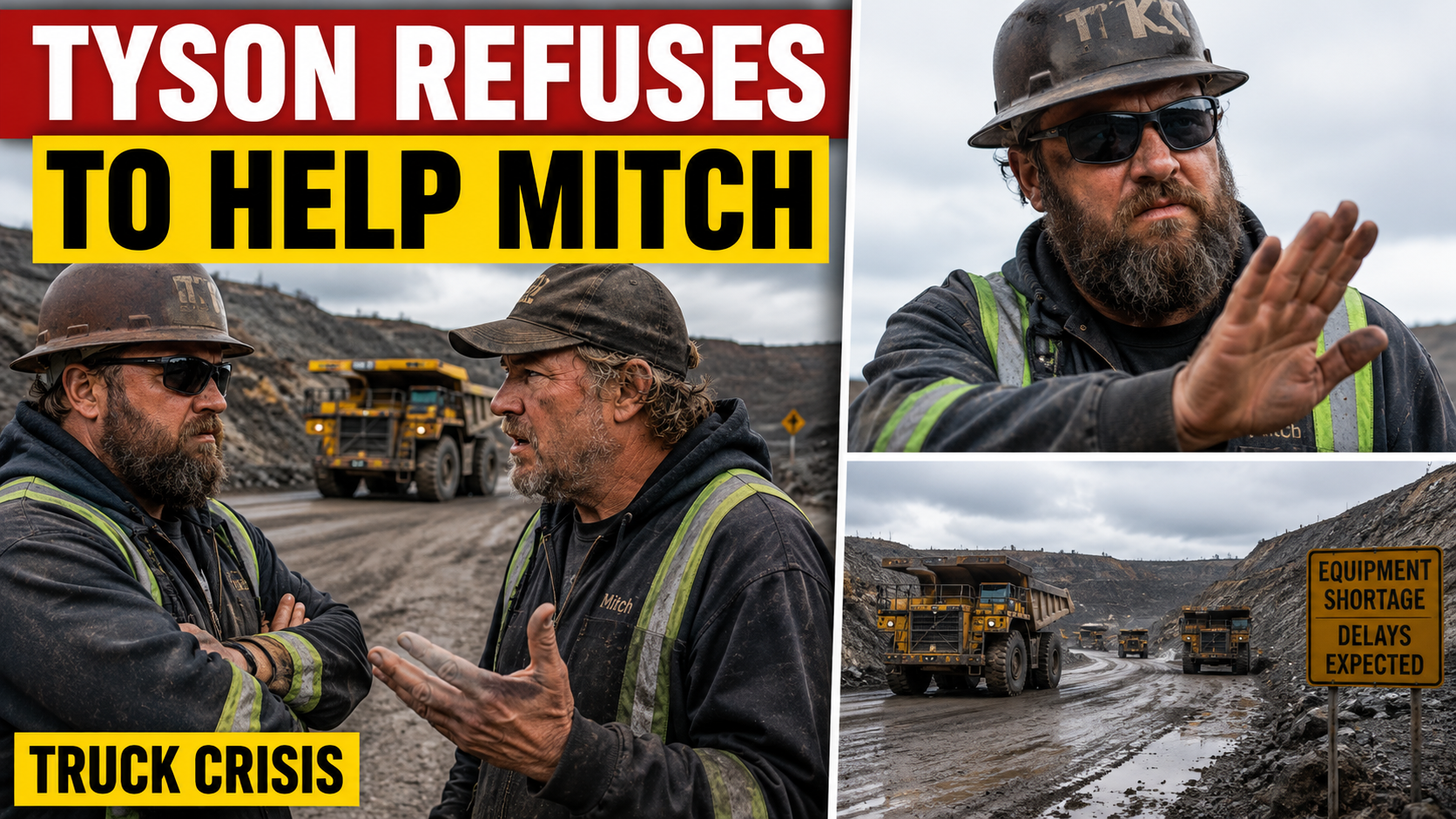
Parker Schnabel’s operation had the equipment, ground, and ambition to produce gold on an enormous scale. What it did not have in early April was spare hauling capacity where Mitch Blaschke needed it most.
Mitch was trying to keep the wash plant Roxanne fed with a skeleton crew and only two rock trucks. That was already a thin margin. A wash plant cannot process promises; it needs a continuous flow of pay dirt. If one truck stops, the plant’s feed can fall sharply. If both stop, the entire chain goes silent.
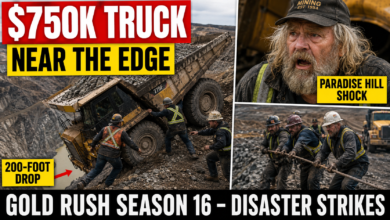
Then driver Billy Abbott had an accident in which his truck came close to tipping. Mitch managed to get the vehicle upright, but the truck had visible damage. Repairs, including difficult bolt extraction, would take time. With one of two trucks unavailable, Mitch’s hauling capacity fell to roughly 50 percent.
He turned to fellow foreman Tyson Lee for help.

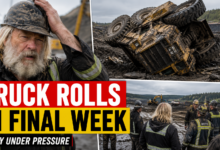

Tyson was overseeing another part of Parker’s operation, associated with three active wash plants. From Mitch’s perspective, the request was obvious: lend a truck or otherwise provide enough support to keep Roxanne supplied. Tyson refused.
The decision left Mitch unhappy and forced his team to rely on a single rock truck hauling continuously through a twenty-four-hour push.
Gold Rush has shown arguments over ground, money, and equipment for years. This conflict was different. It did not place rival mine bosses against one another. It exposed tension between two foremen working for the same owner, each under pressure to protect his own production target.
THE ACCIDENT CREATED AN IMMEDIATE SAFETY AND PRODUCTION CRISIS
A near-tip involving a loaded rock truck is not a minor inconvenience. These machines operate on uneven mine roads while carrying heavy loads. A soft shoulder, poor angle, shifting material, mechanical issue, or driver error can change the truck’s balance rapidly. The available recap does not establish the precise cause of Billy’s incident, so blame should not be assigned without more evidence.
What the recap does establish is that the truck could not simply return to normal hauling. Mitch observed damage, and repairs were required.
That was the correct production consequence. A damaged truck should not be treated as available capacity merely because a plant needs dirt. Bolts, structural points, hydraulics, steering, tires, and other systems may need inspection after an event that places the machine at an unusual angle or load.
For Mitch, however, taking the truck out of service immediately created another problem. Roxanne’s operation had been planned around two trucks. Losing one did not reduce the plant’s hunger by half. It reduced the crew’s ability to satisfy it.
The remaining driver now had to carry the burden. Every cycle—load, haul, dump, return—became essential. A delay at the excavator, a slow section of road, refueling, or a routine inspection could leave Roxanne waiting.
This is why Mitch sought help before the shortage became a full shutdown.
WHY TYSON MAY HAVE SAID NO
From the edited story, Tyson’s refusal can look cold. A teammate asked for assistance during an emergency, and the answer was no.
But Tyson was not standing beside idle equipment with no responsibilities. He was managing a complex area tied to multiple plants. If he gave up a rock truck, loader, operator, or another critical resource, his own feed rates could fall. Parker would then ask why three plants had lost production to rescue one.
Foremen are usually measured by the performance of the operations assigned to them. That creates a rational incentive to protect local capacity. Tyson may have believed that his area could not spare a truck without creating a larger loss. He may also have judged Mitch’s one-truck plan difficult but possible.
The public recap does not provide every discussion, equipment count, route distance, or production calculation behind Tyson’s decision. It would therefore be unfair to state that he refused out of personal hostility or laziness.
Still, the effect was real. Mitch was left to solve a companywide equipment shortage inside his own area, even though the company had resources operating elsewhere.
That points to a leadership problem larger than either foreman.
WHEN LOCAL GOALS DEFEAT THE TEAM
Large businesses often divide work into departments because clear responsibility improves performance. Mining is no different. One foreman may manage a particular cut or set of plants while another manages operations miles away. Each person learns the ground, equipment, and crew in that area.
But division creates silos. A supervisor can meet his own target while the overall company loses money.
Imagine Tyson’s area could spare one truck and lose ten ounces of production, while that truck could prevent Roxanne from losing thirty ounces. From Parker’s perspective, lending the truck would be the better decision. From Tyson’s perspective, it could make his own numbers look worse.
The reverse could also be true. Moving a truck might disrupt three plants and cost far more than Roxanne would gain. In that case, Tyson’s refusal would protect the company even if Mitch disliked it.
The correct answer requires information above the level of either foreman: expected plant recovery, truck cycle times, remaining pay, repair duration, crew coverage, road conditions, and the operational priorities set by Parker.
If Mitch and Tyson were expected to negotiate that conflict alone, Parker’s management structure had failed to provide a clear method for allocating scarce equipment.
PARKER’S ABSENCE FROM THE MOMENT MATTERED
Parker built the operation and ultimately owned the result. As his business expanded, however, he depended more heavily on foremen to make decisions without him.
Delegation is necessary. One mine boss cannot direct every truck or approve every repair. Strong foremen need authority.
But shared resources create decisions that may exceed one foreman’s authority. When two operations compete for the same truck, neither supervisor should have to sacrifice his target based only on who argues harder. The owner or a clearly designated operations manager should establish which plant has priority.
Without that structure, requests for help become personal. Mitch does not hear “the production model says the truck must stay.” He hears Tyson say no. Tyson does not hear “the company needs capacity moved to Roxanne.” He hears another foreman asking him to weaken his own operation.
Resentment grows even when both people are acting rationally.
The episode’s tension may therefore be less evidence of a personal feud and more evidence that Parker’s company had outgrown informal coordination.
THE TWENTY-FOUR-HOUR SOLUTION CARRIED ITS OWN RISK
With no borrowed capacity, Mitch used one truck continuously for a twenty-four-hour push. Operationally, the logic was clear. If the plant could not receive two simultaneous haul streams, the remaining truck had to spend as little time idle as possible.
Continuous operation does not necessarily mean one driver worked twenty-four hours without relief. The recap did not provide full shift details, and it would be wrong to assume an unlawful or unsafe schedule. A mine can run a truck around the clock using multiple qualified drivers.
Even with shift changes, however, dependence on one machine is fragile. The truck must stop for fueling, inspections, maintenance, and any new defect. Tires, brakes, hydraulics, and suspension remain subject to wear. If the single truck fails, hauling falls from half capacity to zero.
The road and loading area must also remain open. A stuck vehicle or excavator problem can stop the only cycle feeding Roxanne.
Mitch’s plan was therefore a survival measure, not a stable system. It could keep the plant alive long enough for repairs, but it offered no redundancy.
The fact that experienced crews sometimes operate this way does not make the pressure imaginary. Many older Americans have seen a factory run on one remaining line, a farm rely on one tractor during harvest, or a trucking company cover a route with its last available vehicle. People become careful, creative, and exhausted because they know there is no backup.
ROXANNE’S CLEANUP DID NOT ERASE THE CONFLICT
Despite the shortage, Roxanne produced 143 ounces in the reported cleanup. That result proved Mitch’s crew could adapt and continue processing gold under extreme pressure.
Success, however, can conceal management failures. Because the crew achieved a strong result, leaders may conclude that the emergency plan was acceptable. The hidden lesson becomes dangerous: if one truck can keep the plant alive, perhaps two trucks were never necessary.
That misunderstands resilience. Emergency performance often depends on extraordinary effort, favorable timing, and luck. It cannot automatically become the new standard.
The right response to a successful recovery is to recognize the crew and then ask why the operation had no spare capacity. Was the fleet too small for the number of plants? Were trucks assigned based on old production assumptions? Could preventive maintenance or operator training reduce future incidents? Did supervisors know how to escalate resource conflicts?
Mitch’s 143 ounces showed what the crew accomplished. It did not prove that Tyson’s refusal caused no harm or that Mitch’s one-truck system was sustainable.
TYSON’S OWN PRESSURE SHOULD NOT BE IGNORED
It is tempting to frame Tyson as the villain because he was the person who said no. That would oversimplify the situation.
Tyson was responsible for delivering results from his assigned operations. He had equipment problems of his own across the season and managed an area with high production expectations. If Parker had provided no genuine reserve fleet, every truck loan was a transfer of risk rather than true help.
In that environment, cooperation becomes costly. A foreman who lends equipment may be praised as a teammate if everything goes well. If his own plant later runs short, the same decision may be criticized as poor judgment.
Organizations create teamwork not by asking people to be generous, but by designing incentives and authority that reward the best total outcome.
Parker could make that expectation explicit: gold recovered by all plants matters more than any foreman’s individual count. Equipment could be assigned through a daily operations plan with contingency rules. A floating truck or maintenance reserve could be kept for emergencies, though that reserve would carry cost when unused.
The best solution may not be adding a machine. It may be improving information. If Tyson could see exactly how much Roxanne stood to lose and Mitch could see the effect of removing a truck from Tyson’s area, the decision would feel less personal.
WHAT THIS SAYS ABOUT PARKER’S RAPID EXPANSION
Parker’s ability to run multiple plants is a sign of remarkable growth. Each plant offers another opportunity to convert prepared ground into gold. But adding plants without enough support equipment and management depth can create a system that is productive only when nothing goes wrong.
Real mining guarantees that something will go wrong.
A truck will need repair. A pump will fail. Mud will change a road. An operator will be unavailable. The purpose of capacity planning is not to eliminate every problem; it is to prevent one problem from threatening the entire operation.
The conflict between Mitch and Tyson suggested Parker’s margins were thin. One near-tip reduced Roxanne’s haul fleet by half. The apparent solution required help from another production area that did not believe it could spare capacity.
That is a warning sign for any expanding business. Growth creates revenue, but redundancy creates survival.
IS THIS REALLY AN INTERNAL RIFT?
The word “rift” should be used carefully. The reported disagreement shows frustration and conflicting priorities. It does not prove a permanent personal break between Mitch and Tyson, nor does it establish that either planned to leave Parker’s crew.
Reality television also compresses hours of work and conversation into a short story. Viewers see the moment that best communicates conflict, not necessarily every compromise before or after it.
Still, workplace relationships are shaped by these moments. Mitch learned that Tyson would protect his own operation during a shortage. Tyson learned that Mitch expected cross-site support. Unless leadership clarified the rules, the next breakdown could revive the same anger.
Healthy teams do not require everyone to agree. They require a trusted method for resolving disagreement.
THE LARGER LESSON
The most important part of the story is not deciding which foreman was selfish. It is recognizing how quickly good employees can be placed against one another by a shortage created above them.
Mitch was responsible for Roxanne. Tyson was responsible for his plants. Parker was responsible for ensuring the company had enough equipment—or a clear plan for sharing too little equipment.
Billy Abbott’s accident triggered the crisis, but it did not create the underlying vulnerability. The vulnerability already existed in a two-truck operation with no obvious backup.
Mitch’s crew kept Roxanne running and recovered 143 ounces. That is a credit to their effort. Tyson’s refusal may also have protected substantial production elsewhere. Without complete operational data, outsiders cannot calculate which allocation would have produced the most gold.
What viewers can see is a business stretched so tightly that helping one teammate threatened another.
Parker Schnabel’s operation had become large enough to run multiple plants and chase historic totals. On April 3, its hardest problem was not finding gold. It was convincing two capable foremen that they were still working toward the same goal.