A FLIPPED ROCK TRUCK THREATENED TONY BEETS’ $45 MILLION SEASON AT THE WORST POSSIBLE MOMENT
A FLIPPED ROCK TRUCK THREATENED TONY BEETS’ $45 MILLION SEASON AT THE WORST POSSIBLE MOMENT
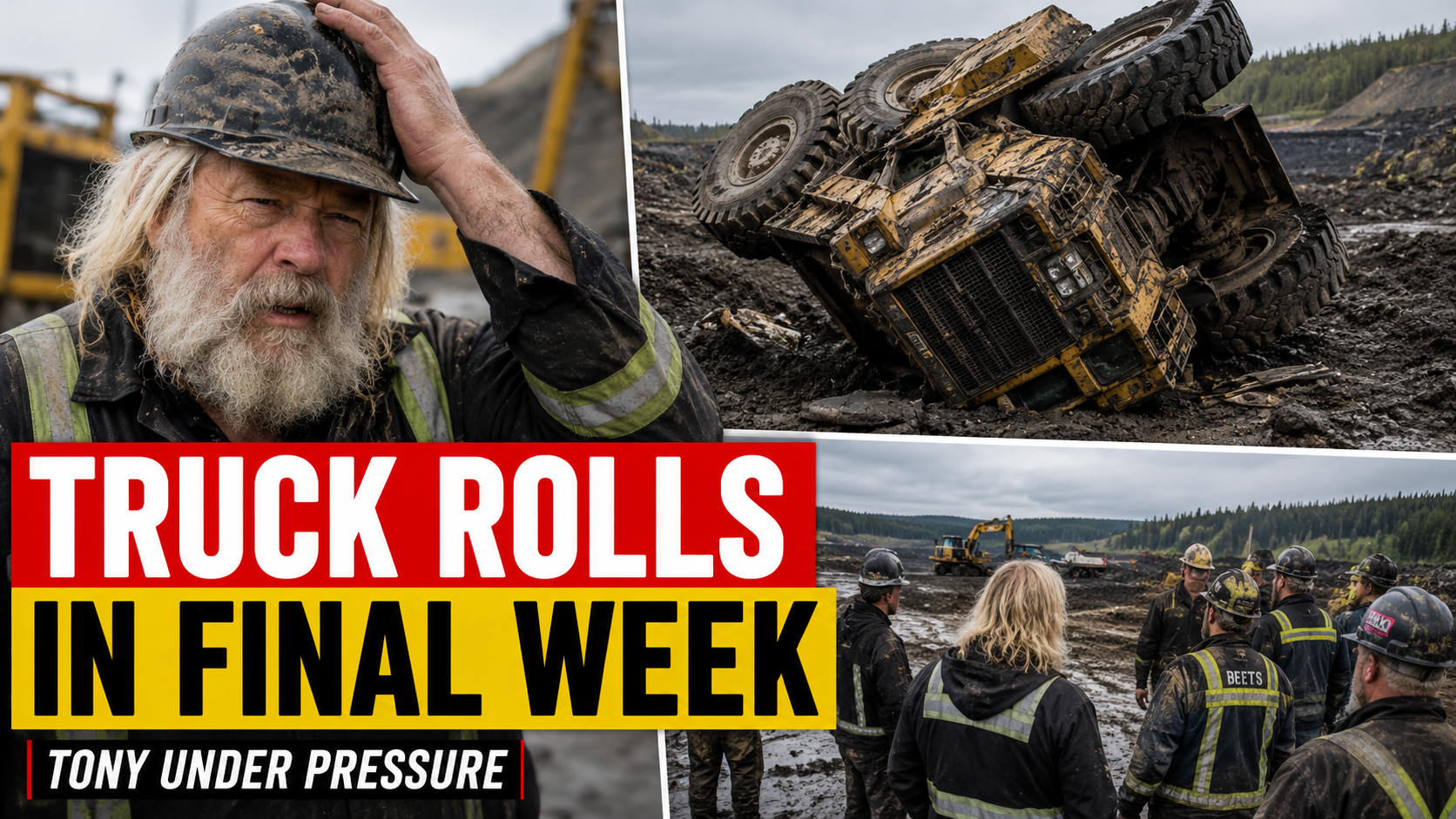
Tony Beets had spent the season building toward a finish few Gold Rush fans had ever seen. Four wash plants were running. Crews were working around the clock. Every cut, truck, and ounce mattered as Tony fought to finish ahead of Parker Schnabel and protect his reputation as the “King of the Klondike.”
Then, in the final week of Season 16, a rock truck flipped at the Early Bird Cut extension.
The timing could hardly have been worse. At that stage of a mining season, there is no comfortable recovery period. There is no extra month to repair a damaged truck, retrain a driver, or make up lost production. Winter is coming, the remaining pay dirt is limited, and the final gold total is close enough to calculate.
According to the season-finale recap, truck driver Scott Easley rolled the box at the Early Bird operation while Tony’s team was pushing to keep Sluice-A-Lot supplied. Tony stepped in as the crew dealt with the incident. The episode turned what should have been a final production sprint into a reminder that one machine, one slope, or one wrong moment can place a multimillion-dollar plan in danger.



Tony ultimately completed a record season. The four operations produced a combined final cleanup that carried him to 11,231 ounces, valued on the program at roughly $45 million. But knowing the final result does not make the truck rollover insignificant. It shows how close a historic success can come to being reshaped by a single accident.
FOUR PLANTS, ONE FINAL PUSH
Tony’s strategy was built on volume. Instead of relying on one wash plant and one cut, he spread production across four active plants: Sluice-A-Lot at the Early Bird Cut extension, Find-A-Lot at the Corner Cut, Harold at the Hester Cut, and the Trommel at Paradise Hill.
Running four plants sounds like an obvious way to recover more gold. In practice, it multiplies almost every problem. Each plant needs a steady supply of pay dirt. Each needs water, fuel, operators, maintenance, and room for tailings. Every truck route must remain usable. Every loader, excavator, and feeder becomes part of an interdependent system.
If one machine stops, the effect can spread. A rock truck failure reduces hauling capacity. Reduced hauling can starve a plant. A starved plant costs gold by the hour even if the plant itself is in perfect condition. Meanwhile, equipment working elsewhere cannot always be pulled away without creating another shortage.
That is the pressure Tony accepted in the final week. His crew was not merely running four separate machines. It was managing four production chains at once, twenty-four hours a day, while the season clock approached zero.
Cousin Mike moved Sluice-A-Lot back into the Early Bird extension for one more run. The objective was straightforward: feed the plant as much profitable material as possible before shutdown. The challenge was that the operation had no room for a major interruption.
The rock-truck rollover struck at the heart of that plan.
WHY A ROLLOVER IS MORE THAN A TELEVISION SCARE
Gold Rush often shows heavy equipment operating on rough, changing ground. For longtime viewers, a truck leaning, sliding, or becoming stuck may look like another familiar obstacle. But a rollover is a serious event.
Rock trucks carry enormous loads over haul roads that can change with weather and use. Their high center of gravity can become more dangerous when a load shifts, a wheel reaches a soft edge, a route is uneven, or a raised box changes the truck’s balance. The exact cause of the Early Bird incident cannot be determined from a recap alone, and it would be irresponsible to assign blame without a full investigation.
What can be said is that the consequences go well beyond lost dirt.
The first concern is the driver. A machine can be replaced; a life cannot. Even when a driver appears able to walk away, a rollover requires careful attention because injuries are not always immediately visible.
The second concern is the truck. A heavy machine that rolls may suffer damage to its frame, cab, hydraulic system, box, suspension, tires, steering, or fluid lines. Recovery itself must be planned so that additional equipment and crew members are not placed in danger.
The third concern is the site. Work may need to stop while the area is secured, the truck is stabilized, and the route is assessed. In an operation that depends on constant hauling, every hour matters.
Finally, there is the human effect. Drivers who watched the incident must return to the same roads under the same production pressure. A responsible crew cannot simply pretend nothing happened. The plan, road conditions, and work pace may need to be reconsidered even when the clock is running out.
TONY’S LEADERSHIP UNDER PRESSURE
Tony Beets has built his television identity around directness. He expects action, dislikes wasted time, and has decades of mining experience. When something goes wrong, he often moves toward the problem rather than waiting for a formal meeting.
That style can be effective in a crisis. A crew needs a clear decision-maker when equipment is down and the season is ending. Tony’s presence also signals that the incident is important enough to demand the mine boss’s attention.
But leadership in a rollover is not only about getting production moving again. It is also about slowing down long enough to protect people, determine what can safely continue, and avoid turning one event into two. The tension between urgency and caution is one of the most important realities shown on Gold Rush.
Television naturally emphasizes the race. Viewers hear what a shutdown could cost and how many ounces are still needed. Yet the safest decision may not be the fastest decision. A record total is meaningful only if the people responsible for producing it go home.
The Early Bird incident therefore became a test of Tony’s entire operation. Could a large, fast-moving crew absorb a major disruption without losing control of the final week?
The answer, based on the final total, was yes. But it was not the only problem the Beets family faced.
THE TROMMEL ALSO FOUGHT BACK
While attention centered on the flipped truck, son Mike Beets encountered trouble at the Trommel. Overnight tailings had built up and spilled into the distributor box, where a clog blocked the system.
That problem illustrates why Tony’s four-plant strategy was so difficult. Even after one crisis receives attention, another plant can fail somewhere else. The mine boss cannot stand beside every machine. Success depends on family members, foremen, mechanics, and operators identifying problems early and making sound decisions without constant supervision.
A blockage at the distributor can interrupt the even movement of material and water through the plant. Clearing it is not glamorous work, but an unresolved clog can reduce recovery, damage equipment, or stop production entirely. Near the end of the season, maintenance tasks that might once have been routine become financially charged.
Every breakdown is translated into time. Time is translated into yards. Yards are translated into expected ounces. That chain is what makes a few silent hours feel catastrophic.
THE FINAL WEIGH REVEALED THE SCALE OF THE GAMBLE
When the final gold was counted, each plant showed why Tony had accepted the complexity.
Find-A-Lot’s Corner Cut cleanup delivered 202.18 ounces. Sluice-A-Lot at the Early Bird extension added 266.96 ounces. Harold at the Hester Cut contributed 132.12 ounces. The Trommel, despite its trouble, produced an extraordinary 417.36 ounces.
Together, those results helped lift Tony’s season total to 11,231 ounces. The program valued the haul at approximately $45 million and described it as his biggest season.
Those figures are gross gold value as presented in the television recap, not the same thing as profit. Fuel, payroll, royalties, equipment purchases, repairs, and other operating costs must be paid. A large gold total can still come with enormous expenses.
Still, the number represented a remarkable operational achievement. Tony did not reach it with one perfect plant. He reached it by assembling enough production capacity that the overall system could survive problems at individual points.
That is the strength of diversification in mining. If one cut disappoints, another may produce. If one plant stops, the others can continue. But diversification also creates more opportunities for failure. Four plants provide four paths to gold and four sets of moving parts that can break.
THE ACCIDENT CHANGED HOW THE RECORD SHOULD BE VIEWED
Without the rollover, viewers might remember the finale mainly as a scoreboard: Tony versus Parker, 11,231 ounces, $45 million, another crown for the veteran miner.
The accident adds a different meaning. It reminds the audience that records are not produced by numbers alone. They are produced by drivers repeatedly traveling the same haul road, mechanics answering calls in the middle of a shift, plant operators watching water and feed, and supervisors making decisions while tired.
The closer a crew gets to a target, the easier it can be to see every delay as an enemy. That is precisely when judgment matters most. A production goal can motivate people to solve problems, but it must never become permission to ignore warning signs.
There is no public basis in the available recap to claim that Tony ordered unsafe conduct or that the rollover resulted from a particular policy. The incident should not be turned into an accusation unsupported by evidence. It should be treated as a visible example of the hazard built into large-scale earthmoving.
For viewers who have driven trucks, operated farm machinery, worked construction, or supervised industrial crews, that distinction will feel familiar. Accidents can occur even in experienced operations. The important questions are how risk was managed beforehand, how the crew responded, what was learned, and whether the same conditions were corrected.
A DIFFERENT KIND OF COMPETITION WITH PARKER
Season 16 framed Tony and Parker as rivals for the top position. The competition gave every cleanup additional drama. Tony’s final total allowed him to retain the crown, while Parker’s operation also reached extraordinary levels.
But the rollover exposes the limit of treating mining like a simple race. Parker and Tony can compare ounces, yet each crew operates different ground, equipment, costs, and risks. The first-place total does not explain the quality of every decision made along the way.
Competition can improve performance. It encourages investment, planning, and persistence. It can also magnify pressure. When a crew believes one lost shift may decide an entire season, people can feel compelled to hurry.
The best mine boss is therefore not simply the person willing to push hardest. It is the person who knows where pushing creates value and where it creates unacceptable risk.
Tony’s season demonstrated both the power and fragility of scale. He built an operation capable of producing more gold than ever before, but the final week showed how much depended on ordinary pieces of the system continuing to function.
WHAT LONGTIME FANS WILL REMEMBER
Fans may remember the huge Trommel cleanup or Tony’s satisfaction at the final weigh. They may remember the four plants running at once and the confirmation that the veteran miner could still outproduce a younger rival.
But the image of the flipped truck belongs beside the gold. It is the moment that strips away the comfort of the final number. Before the weigh-in, no one at Early Bird could know with certainty that the season would end in celebration.
The incident also reflects why Gold Rush remains compelling after so many seasons. The machinery is larger and the gold totals are higher, but the basic uncertainty has not changed. Success is never guaranteed. A season can be planned in winter, financed in spring, and built through months of work—then threatened in seconds.
Tony Beets finished with a record. That outcome deserves recognition. So does the crew that kept multiple plants operating through the final push.
Yet the most important lesson is not that Tony overcame a delay and still made $45 million worth of gold. It is that no gold total can make a rollover routine.
In the final week, Tony’s operation proved it could recover from a frightening disruption. The lasting question is whether every lesson from that disruption will matter as much as the record written into the season finale.