Parker Schnabel’s Worst Breakdown in 13 Years Came With a 20-Second, Million-Dollar Repair Window
Parker Schnabel’s Worst Breakdown in 13 Years Came With a 20-Second, Million-Dollar Repair Window
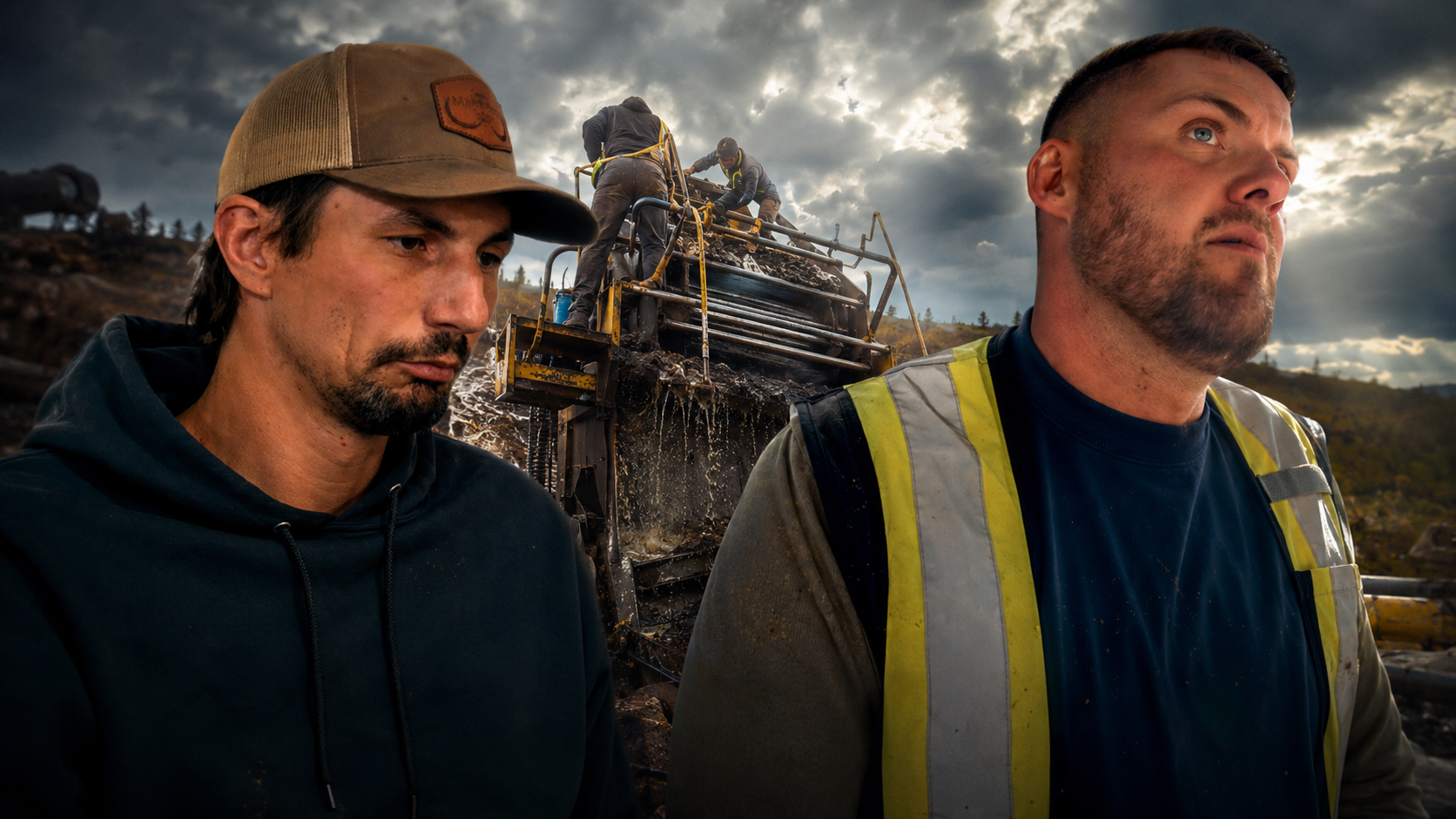
The most expensive 20 seconds of Parker Schnabel’s season began long before anyone started the clock.
They began when Roxanne’s shaker deck stopped moving correctly.
A wash plant can dominate the landscape around it. Steel, conveyors, pumps and roaring water make it appear permanent, almost indestructible. Yet its ability to produce gold may depend on a single shaft turning inside a housing, supported by bearings fitted to tolerances that leave almost no room for error. When that hidden assembly fails, the entire operation can become a collection of expensive machines waiting for one small part to move again.
At Parker’s operation, the failure came at an especially vulnerable moment. Mitch Blaschke was away, and Brennan Ruault had stepped into greater responsibility. Brennan’s return to Parker’s crew already carried history. He was not a stranger learning the mine for the first time; he was a former key employee coming back into a demanding organization with old experience and fresh expectations. Roxanne’s breakdown turned that reunion into a test.




The initial inspection revealed the seriousness of the problem. A hole had developed in a cylinder associated with the shaker system, and the repair required the team to remove and replace a shaft and bearings. This was not a matter of welding a crack, changing a belt or installing a spare motor. The damaged assembly sat at the heart of the motion that allows the shaker deck to process material. Without it, Roxanne could not perform the work for which the entire surrounding operation existed.
Parker called it the worst breakdown he had faced in 13 years. The statement described more than mechanical complexity. It described exposure. If the repair failed, the plant could remain silent for weeks while parts or specialized help were arranged. During that time, stockpiled pay would remain unwashed, loaders and operators would lose productive work, and a major stream of Parker’s season total would disappear.
The potential cost reached into the millions.
The repair plan depended on a principle that experienced mechanics know well: metal changes size with temperature. Heat causes the housing to expand. Cold causes the bearing to contract. By heating one component and chilling the other, the team could temporarily create enough clearance to install a bearing that would be held tightly once both parts returned toward the same temperature.
The concept was straightforward. The execution was unforgiving.
The housing had to be heated to around 450 degrees while the bearing was kept cold. Once the parts were moved into position, the team had only about 15 to 20 seconds before temperature began closing the advantage they had created. If the bearing entered crooked, paused halfway or met resistance, it could become stuck. Removing a partially installed bearing might damage the new component, the housing or both. The next attempt might require new parts that were not sitting nearby.
That narrow window transformed the repair into a choreography. Everyone needed to know where to stand, what to hold and what to do if the first motion did not go perfectly. Tools had to be within reach. The path between the chilled bearing and the heated housing had to be clear. Communication had to be short and precise. No one could begin while another person was still deciding how to move.
Television naturally focuses on the countdown, but the real quality of such a repair is determined before the countdown begins. Preparation is what turns 20 seconds from a gamble into a controlled procedure. The crew had to measure, inspect, clean, heat and cool the right surfaces. They needed to confirm orientation and rehearse the movement. A heroic last-second shove cannot compensate for a burr, misalignment or missing tool.
For Brennan, the moment carried a second layer. He was not merely helping to repair Parker’s plant. He was acting as the responsible leader while one of Parker’s most trusted foremen was absent. Any uncertainty about whether Brennan could still perform inside Parker’s high-output system now had a direct answer waiting in the housing. If the repair succeeded, Roxanne could return to work and Brennan’s judgment would gain credibility. If it failed, the consequences would be measured in downtime and lost gold.
Parker’s management style increases that pressure. His operations have grown larger and more complex because he expects people to handle responsibility without constant supervision. He sets aggressive targets and calculates downtime in lost ounces. A foreman is not praised simply because everyone worked hard. The plant must run. The pay must be processed. The season must remain on schedule.
That standard can appear cold, but mining economics are cold. A wash plant does not earn money while a crew explains why a repair was difficult.
At the same time, Parker had to rely on people. He could not personally perform every diagnosis and installation across several active plants. Growth had made delegation unavoidable. The Roxanne failure therefore tested Parker’s system as much as Brennan’s skill. Had he placed capable people in the right positions? Could the crew solve a rare, high-consequence problem without Mitch? Would Parker allow Brennan enough authority to act, or would the fear of losing millions cause him to interfere?
Trust on a mine is not a sentimental idea. It is the willingness to let another person make a decision that can stop or save production.
The bearing installation brought that truth into a single instant. The chilled metal was ready. The housing had been brought to the required heat. Once the crew committed, there was no opportunity for a meeting. They had to move.
The bearing went in.
That success can look inevitable after the fact. It was not. The crew’s preparation created the smooth motion viewers saw, but the risk remained real until the component seated correctly. When it did, the repair crossed its most dangerous threshold. The parts could return toward normal temperature, tightening the fit that would allow the shaft to operate under load.
Even then, a responsible team would not treat installation as proof of completion. The assembly had to be finished, aligned and tested. Lubrication, seals, fasteners and connected components needed attention. The shaker system had to run without abnormal heat, sound or vibration. A bearing can be installed successfully and still fail early if alignment is wrong or the underlying cause of the original damage remains.
That last point is critical. Replacing broken components restores function, but it does not automatically explain why they broke. A hole in a cylinder and damage to a shaft or bearing system can result from wear, contamination, misalignment, overload, lubrication problems or a combination of conditions. If the crew repaired only the visible failure without examining the cause, Roxanne could return to service carrying the same threat.
The best post-repair question is not “Does it run?” It is “Why will it keep running?”
Parker’s operation had millions of reasons to ask.
The episode offered viewers a rare glimpse of the difference between owning machinery and managing machinery. Anyone can be impressed by the size of a plant or the weekly value of its gold. The real business lives in maintenance histories, spare-part decisions, inspection routines and the competence of mechanics who understand how steel behaves at 450 degrees. Production numbers are built on details most people never see.
That is why the phrase “worst breakdown” did not necessarily mean Roxanne suffered the largest visible destruction. A catastrophic-looking failure can sometimes be repaired quickly if common parts are available and access is easy. A modest-looking internal defect can be far more dangerous if it requires precision work, rare components or a long wait. Severity is measured by the risk to production, not by how dramatic the damage appears.
Roxanne’s failure threatened to remove one of Parker’s major plants from the season at exactly the point when every remaining day mattered. The crew’s stockpile did not create value until it passed through the plant. Gold in unwashed dirt may support optimism, but it does not pay the bills. Weeks of downtime would have trapped expected revenue on the ground.
For older viewers who have spent years maintaining equipment, the repair carried a familiar tension. The public often celebrates the entrepreneur or mine boss, but a business can turn on the judgment of the person holding a bearing near a hot housing. Years of growth, financing and planning may depend on a mechanic completing a task that outsiders will never understand.
Brennan’s role made that dependence personal. His history with Parker meant the breakdown could have reopened old doubts. Instead, it gave him a chance to demonstrate that experience had value when the operation was under maximum strain. Leadership in that moment did not require a speech. It required keeping people organized while the plan moved from diagnosis to precision execution.
The repair also offered Parker evidence that his mine could survive the absence of one indispensable person. Mitch is valuable precisely because he solves problems, but any large operation becomes fragile if only one individual can handle a crisis. Brennan’s successful stewardship did not reduce Mitch’s importance. It strengthened the organization by adding another person capable of carrying responsibility.
That may be the most valuable outcome beyond the recovered production. Gold seasons end. Organizational capacity remains.
There is a temptation to describe the event as Parker “almost losing millions” because one bearing nearly refused to fit. The more accurate story is that the millions were protected by a chain of competence. Someone recognized the failure. The team understood the assembly. Parts were available or obtained. A thermal-fit procedure was selected. The housing and bearing were prepared. The crew coordinated the installation. Each step removed one form of uncertainty.
The final 20 seconds received the drama, but the hours before them created the result.
This is also why aggressive production goals must include maintenance capacity. Parker pushes multiple plants because additional throughput can deliver extraordinary totals. Every extra machine also adds failure points. Four plants do not merely multiply production; they multiply bearings, shafts, pumps, belts, motors and crews that must be supported. Scale rewards a mine only when its maintenance system grows with it.
Roxanne’s breakdown was a warning from that larger system. Parker’s operation was powerful enough to generate huge weekly returns, but no size made it immune to a small internal failure. The greater the production, the more expensive each silent hour became.
After the repair, Roxanne could return to what viewers usually see: water, dirt and gold totals. The crisis would disappear inside the normal rhythm of the mine. Yet Brennan and the crew would know that the season had passed through a gap measured in seconds. A tilted bearing, a delayed movement or an incomplete plan could have produced weeks of consequences.
Parker’s statement about 13 years captured the rarity of the challenge. His career has included floods, fires, broken equipment and difficult ground. Calling this the worst breakdown placed unusual weight on the repair. It also made the crew’s success a significant achievement rather than another convenient television resolution.
The repair record should now become preventive knowledge: measurements, temperatures, part numbers and the symptoms that appeared before failure. Capturing those details would let the next crew respond before another 20-second installation carries the season.
For Brennan, the result did not erase every question about his return or guarantee that future problems would go smoothly. It did something more concrete: when Parker’s plant faced a potentially season-altering failure and Mitch was away, Brennan helped get it moving again. Trust built under those conditions carries more weight than trust discussed in a meeting.
For Parker, the episode confirmed both the vulnerability and resilience of the operation he had built. Roxanne could be stopped by internal damage. The mine could recover because the people around it knew how to respond.
And for the audience, those 20 seconds revealed where a modern gold mine’s fortune really lives. Not only in the ground. Not only in the wash plant. It lives in the narrow space between hot steel and a frozen bearing, where preparation, timing and human judgment decide whether millions of dollars keep moving or remain buried in a pile of dirt.