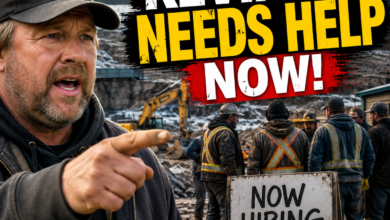
Mike Beets Invited His Family to Watch His Trommel Start—Tony Shut It Down Within Minutes
Mike Beets Invited His Family to Watch His Trommel Start—Tony Shut It Down Within Minutes

Mike Beets did not gather his family at Paradise Hill to watch another test. He invited them to witness a beginning.
For weeks, the Trommel had represented everything he wanted to prove. It was large, difficult and delayed—the kind of project that could establish a son as a mine boss if he finally brought it to life. Mike had lived with the waiting, the repairs and the questions. Now the machinery was ready to move. The family was present. The moment had the shape of a handover ceremony even if no one formally called it one.
Then Tony looked at the plant.
As dry material began to pile backward toward the feed conveyor, Tony recognized the problem almost immediately. The prewash did not have enough water. Dirt that should have been moving cleanly through the system was backing up, and continuing to run risked turning an anticipated celebration into a more serious mechanical mess. Tony ordered Mike to shut the Trommel down.


The command lasted only seconds. Its meaning was much larger.
For Mike, the startup was supposed to demonstrate that he had finally completed the job and could run his own ground at Paradise Hill. For Tony, a machine either worked correctly or it did not. The family gathering, the weeks of effort and the emotional importance of the occasion could not change what he saw in front of him. The dirt was backing up. The plant needed to stop.
That difference between the two men explains why the scene landed so hard. Mike was experiencing the moment as a son seeking recognition. Tony was judging it as an owner watching an operation risk damage and downtime. One was looking at what the startup represented. The other was looking at what the material was doing.
Both perspectives were real, but only one had the authority to hit the brakes.
The first water problem might have been survivable as an embarrassing commissioning issue. New and rebuilt systems often reveal flaws only when all the parts operate together under load. A plant can look complete while stationary and still expose poor flow, alignment or capacity when the first pay dirt arrives. In that sense, finding a problem during startup is not proof that an entire project is a failure. Startup is when hidden problems are supposed to become visible.
What damaged Mike’s moment was what came next.
After the water issue was addressed, the team discovered that the conveyor system was missing important rollers. The Trommel was not simply suffering from one adjustment that could be corrected and forgotten. It was still incomplete. The second problem changed the story from an unlucky startup snag to a broader question about oversight. How had a family celebration been scheduled before someone verified that the plant had the components required for sustained operation?
Mike pointed toward Len Hoekstra, the veteran fabricator and trusted member of the Beets operation who had been involved in the work. Tony refused to let that explanation settle the matter. In his view, Mike owned the responsibility because Mike was the one leading the project. The detail of who failed to install or order a part mattered less than the chain of command.
It was Mike’s party, and therefore Mike’s problem.
That may sound harsh, especially in a family where Tony’s presence can overwhelm almost any attempt by his children to lead. Minnie had already tried to stop Tony from simply taking control. She understood that Mike could not prove himself if his father seized the wheel every time a difficulty appeared. Independence requires room to make decisions, solve problems and occasionally fail without the founder erasing the experience.
But independence also carries a condition that is often forgotten when people demand more freedom: the person receiving authority must accept the final responsibility. Mike could not reasonably ask Tony to step back when things were going well and then transfer blame to Len when a missing component stopped the plant. If Paradise Hill was Mike’s operation, the pre-start checklist was also Mike’s.
That is the painful fairness in Tony’s response.
Family businesses frequently struggle at exactly this boundary. A parent spends decades building an enterprise through instinct, sacrifice and relentless attention. A son or daughter wants a genuine chance to lead, not a ceremonial title with the founder making every decision. The founder agrees in principle but keeps seeing dangers the next generation has missed. The successor interprets every intervention as proof that the parent will never let go. The parent interprets every overlooked detail as proof that the successor is not ready.
The conflict feeds itself.
At Paradise Hill, the Trommel became a physical version of that cycle. Every delay gave Tony another reason to doubt Mike. Every time Tony redirected equipment, criticized the schedule or stepped close to taking over, Mike had another reason to feel that he was being denied the conditions required to succeed. By the startup, the machine carried months of frustration that had little to do with rollers or water.
Mike wanted one clean, undeniable moment. Instead, he gave Tony evidence.
The scene should not be reduced to the idea that Tony humiliated his son for entertainment. The dry dirt was a real operational warning. A feed system that is not washing and moving material properly can clog, spill, overload components and create more downtime. Shutting the plant down was the prudent response. No responsible boss should keep a malfunctioning system running merely because relatives have gathered to watch.
The more legitimate criticism concerns preparation. The celebration began before the commissioning process was complete. On a complex plant, ceremonial startup and operational startup should not be treated as the same event. The team should first run water, check flow, confirm belts and rollers, test conveyors without load, introduce a limited amount of material and watch every transfer point. Only after those checks succeed does it make sense to call the family and declare the machine ready.
Had Mike followed that sequence, Tony might have arrived to see a functioning Trommel rather than become the person who stopped it. The technical mistake created the emotional confrontation.
There was also a leadership mistake in the way Mike responded. Blaming Len may have been understandable in the heat of disappointment. If Len had responsibility for a particular portion of the build, Mike had reason to be angry that the rollers were missing. Yet a leader gains credibility by first owning the result in public and investigating the failure afterward. Saying, in effect, “This is my operation, and I should have verified it,” would not have made the rollers appear. It might have changed what Tony saw in his son.
For experienced viewers, that distinction is familiar. A boss does not personally tighten every bolt, order every part or inspect every weld. Delegation is unavoidable. Accountability is not. The person in charge creates the system that confirms delegated work is finished. When the system fails, the leader can correct an employee without pretending that the failure belongs only to that employee.
Tony’s own leadership is hardly free from contradiction. He demands that his children take responsibility, yet his forceful personality can make it difficult for them to exercise authority. He can reassign equipment, change priorities and enter an operation with the power to overrule everyone. When outcomes are poor, he can still judge the child as if that child controlled every condition. A successor working under those circumstances may carry accountability without possessing full control.
That tension deserves to be acknowledged in Mike’s favor. Paradise Hill did not exist in isolation from the larger Beets strategy. Tony’s decisions about manpower, machinery and where the family could earn the most gold affected the pace of Mike’s project. If resources were moved to more profitable ground, Mike’s delays were not automatically evidence of laziness or incompetence. They could also reflect the founder’s priorities.
Even so, the startup itself was within Mike’s immediate responsibility. No strategic conflict required him to invite the family before verifying water and rollers.
The missing rollers were especially damaging because they were visible, countable parts. They did not require expert geological interpretation or a lucky drill result. Their absence suggested that the project lacked a final inspection. In a business built around heavy moving equipment, such oversights can be more than embarrassing. They can damage belts, create unstable loads and expose workers to avoidable hazards during rushed repairs.
That is why Tony’s anger cannot be dismissed as an old man refusing to praise his son. He saw an operation being presented as complete when it was not complete. To a man whose fortune depends on machines running through a short northern mining season, that gap between presentation and reality is intolerable.
The family setting made the correction more painful. A private test failure would have been a job-site problem. A failure in front of Minnie, Tony and the rest of the family became a judgment on Mike’s readiness. The people he wanted to impress became witnesses to the shutdown. Television preserved the moment and invited millions of viewers to choose sides.
Mike’s future as a leader will depend on what he takes from it.
He could decide that Tony will never give him a fair chance and treat the shutdown as another example of impossible expectations. There is evidence for that frustration. Tony’s style is intrusive, blunt and rarely designed to protect anyone’s pride. Or Mike could treat the scene as the most useful checklist he will ever receive: never schedule the victory before the system has passed its tests; never assume a delegated task is complete; never blame a subordinate before owning the final result.
The second response would do more to create the independence he wants.
Succession is not achieved when the founder finally stops criticizing. It is achieved when the next leader builds an operation so well controlled that the founder has fewer valid reasons to intervene. Mike cannot change Tony’s personality. He can change whether Tony finds dry dirt backing into a conveyor when he arrives.
There is a lesson for Tony as well. If he truly wants his children to become capable bosses, he must distinguish between protecting the mine and dominating the moment. Ordering the shutdown was necessary. Taking permanent control would not necessarily be. The best response after preventing damage would be to require Mike to diagnose the failures, organize the repair, establish a new commissioning plan and report when the plant is genuinely ready. That preserves safety while leaving the learning—and the responsibility—with the successor.
Minnie’s intervention points toward that balance. She was not asking Tony to ignore a malfunction. She was protecting the space in which Mike could become accountable. A parent who solves everything teaches dependence. A parent who watches a preventable disaster without speaking teaches nothing. The difficult middle path is to stop the danger and then return the problem to the person who is supposed to lead.
The Trommel eventually may produce gold, and months from now the missing rollers may look like a small detail in a long mining season. But the startup will remain important because it revealed the true state of the Beets succession. Mike had enough authority to organize a family ceremony. Tony still had enough authority to end it with one command. Between those two facts was a machine that had not been fully checked.
That is where the family’s argument will continue to live.
Mike’s disappointment was genuine. He had worked toward a moment of recognition and saw it disappear almost as soon as the dirt began moving. Tony’s judgment was also grounded in reality. The plant lacked proper water flow, and then it lacked rollers. Pride could not be allowed to keep it running.
The lasting question is not whether Tony spoiled Mike’s celebration. He did. The more important question is whether Mike can use the humiliation to become the kind of leader whose next startup does not require his father’s rescue.
At Paradise Hill, the Trommel failed its first public test. In the same instant, Mike was given his own.