KEVIN BEETS REFUSES TO ASK TONY FOR HELP AS DEBT AND BREAKDOWNS CLOSE IN
KEVIN BEETS REFUSES TO ASK TONY FOR HELP AS DEBT AND BREAKDOWNS CLOSE IN
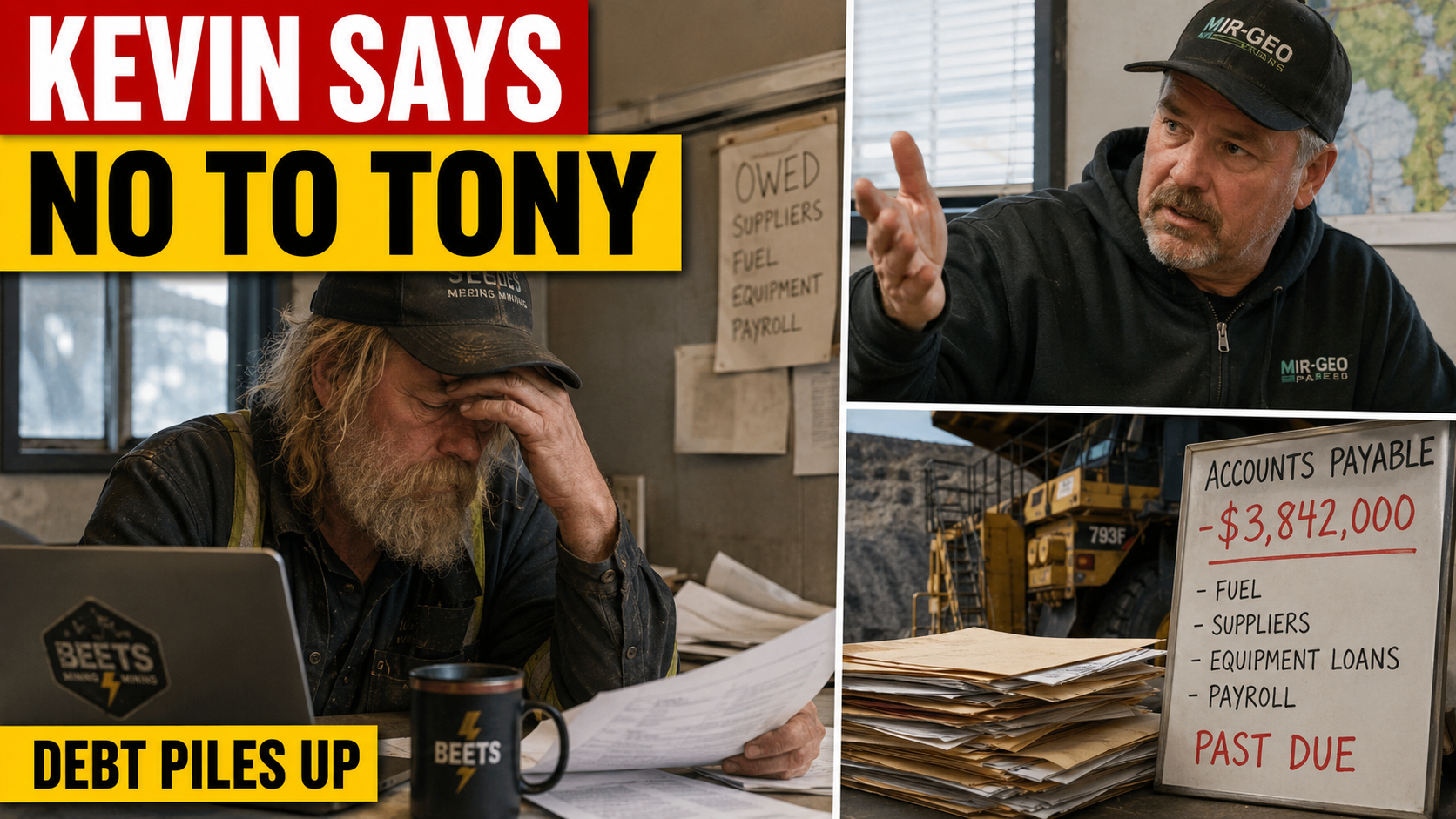
Kevin Beets wanted to prove that he could build a mining operation on his own terms. That goal has followed him through one of the most personal story lines in Gold Rush: stepping away from the protection and control of the Beets family business, accepting responsibility for his own bills, and trying to show that years spent working under Tony had prepared him to become a mine boss.
By April 10, 2026, the dream had reached its hardest test.
Faith Teng reviewed the operation’s finances and told Kevin they were badly behind their gold target and “drowning in debt,” according to the episode recap. She proposed the option Kevin least wanted to consider: ask his father, Tony Beets, for help.
Kevin refused.


His decision was immediately understandable and dangerously expensive. If he turned to Tony, he risked confirming the fear that his independent operation could survive only because the family patriarch rescued it. If he refused, he would have to absorb every breakdown and lost hour with money the business did not have.
Then the grizzly bars failed.
The breakdown stopped the plant for approximately six hours and was estimated on the program to cost about $16,000 in lost production. Kevin also needed Gary Masters back on site. The recap said Gary cut his honeymoon short to help keep the operation running continuously.
The sequence created one of the season’s sharpest questions: Was Kevin protecting the independence he had worked for, or allowing pride to put the entire business at risk?
FAITH’S WARNING CHANGED THE ARGUMENT
Debt in a mining operation can be difficult for television viewers to evaluate because the program often speaks in gross gold value. A cleanup worth hundreds of thousands of dollars sounds like success. But gold recovered is not the same as cash remaining after expenses.
Fuel must be purchased before the gold is found. Employees must be paid. Equipment requires parts and service. Royalties or lease obligations may apply. Contractors, transportation, insurance, and camp costs continue whether a week’s cleanup is strong or weak. A mine may produce impressive gold and still face a cash crisis.
Faith’s role brought those invisible pressures into the open. She was not judging the operation by one exciting weigh-in. She was looking at the distance between the season goal and actual production, then comparing the value coming in with the obligations already accumulated.
When she said the operation was drowning in debt, the phrase carried more weight than the ordinary Gold Rush deadline. It suggested that Kevin was not merely at risk of missing a television target. He was at risk of ending the season with bills that future gold would have to repay.
That is why asking Tony became a real option. Tony has equipment, experience, ground, people, and decades of operational knowledge. He may be difficult, demanding, and emotionally complicated for Kevin, but he is also the most obvious source of emergency support.
Kevin’s refusal was therefore not based on the absence of help. It was based on the price he believed that help would carry.
THE COST OF ASKING A FATHER WHO IS ALSO A MINE BOSS
Family businesses blur boundaries that ordinary companies keep separate. A loan is never only a loan. A piece of borrowed equipment may come with advice, criticism, or influence. A father’s assistance can feel like a parent helping a child even when the child is an experienced adult with years of professional skill.
Kevin spent much of his mining career inside Tony’s operation. He knew the advantages of the family empire, but he also knew the frustration of working under a powerful personality. Building his own operation meant having the freedom to make decisions, establish priorities, and accept the consequences.
If Kevin called Tony at the first major financial crisis, independence could appear temporary. Tony might reasonably want to know how the money would be repaid, how the operation would change, or why Kevin’s plan had fallen behind. Even if Tony imposed no formal condition, Kevin might feel that every future success came with an asterisk.
For many older viewers, this is a familiar conflict. Parents spend years building a farm, shop, company, or trade. Their adult children want to continue in the same field but not remain permanent employees. The parent sees experience and resources that could prevent mistakes. The child sees a need to make decisions without being overruled.
Neither side is automatically wrong.
The danger comes when proving independence becomes more important than preserving the business. A mine that collapses under debt does not demonstrate strength merely because it rejected help.
BROKEN GRIZZLY BARS TURNED PHILOSOPHY INTO MONEY
The grizzly bars at a mining plant perform a basic but essential job. They screen out material too large to enter the processing system. When they fail, oversized rocks can move where they do not belong, feeding can become unsafe or ineffective, and the plant may need to stop.
Kevin’s six-hour shutdown made the financial problem visible. The estimated $16,000 loss was not necessarily an invoice placed on his desk. It represented production the operation expected but could not recover during the downtime.
Lost-production estimates depend on assumptions about feed rate, ground value, and recovery. They should not be confused with a verified net loss. Yet the basic point remains: when a plant is already behind target, six idle hours cannot be replaced simply by working harder unless capacity and time remain.
The breakdown also showed how debt changes every maintenance event. A well-capitalized operator may treat a six-hour repair as an unwelcome but manageable cost. A heavily indebted operator sees the same repair as a threat to payroll, parts purchases, and the ability to finish the season.
This is the cruel cycle of an underfunded operation. Limited cash can delay preventive maintenance or reduce spare-parts inventory. More breakdowns follow. Breakdowns reduce production. Reduced production makes cash even tighter.
There is no public evidence in the recap that Kevin neglected maintenance or caused the grizzly failure. Mechanical components can break in demanding service. The concern is that his financial position left very little room to absorb ordinary mining problems.
GARY MASTERS’ RETURN REVEALED ANOTHER KIND OF DEBT
Money was not the only resource Kevin lacked. He also needed people willing and able to keep the operation running around the clock.
Gary Masters’ reported decision to shorten his honeymoon and return to work demonstrated extraordinary commitment. A dependable crew member answering an emergency call can save a season. For Kevin, Gary’s presence offered experience and coverage at a moment when the plant could not afford more downtime.
But the story also raises a question about dependence. If the operation requires a key worker to interrupt a once-in-a-lifetime personal event, is the business properly staffed?
Viewers should be careful not to invent conflict. The available recap does not establish that Gary was forced to return or that Kevin acted improperly. Gary may have chosen freely to help a friend and employer. Mining crews often build strong loyalty because people face difficult conditions together.
Still, labor has a cost even when it is paid in loyalty rather than dollars. A business can owe its survival to sacrifices that never appear on a balance sheet. Spouses, families, and employees absorb the consequences of emergency schedules.
Faith’s books showed financial debt. Gary’s return revealed human debt.
WHY KEVIN’S REFUSAL WAS NOT SIMPLE STUBBORNNESS
It would be easy to call Kevin proud and end the story there. That explanation is emotionally satisfying but incomplete.
Mining decisions depend on control. If outside help changes who controls equipment, ground, staffing, or gold, the long-term cost can exceed the short-term rescue. Kevin may also have believed that his operation still had a realistic path to recover without Tony.
A mine boss who seeks help too quickly can lose the confidence of workers, partners, and creditors. Employees need to believe leadership has a plan. Constantly turning to a parent can weaken that authority.
There is also value in learning to solve problems. Every successful independent operator eventually faces the moment when old protection is no longer available. If Kevin could survive the crisis through better scheduling, repairs, and production, he would emerge with knowledge no loan could provide.
The problem was not that he wanted to solve it himself. The problem was the shrinking margin for error.
Pride becomes dangerous when it prevents a leader from accurately measuring risk. Independence is not refusing every lifeline. It is choosing help deliberately, understanding its terms, and remaining responsible for the result.
WHAT TONY’S HELP MIGHT HAVE LOOKED LIKE
The episode discussion did not establish a formal offer from Tony or exact terms. “Ask Tony” could have meant many things.
Kevin might have requested temporary equipment, an experienced operator, mechanical support, access to parts, short-term financing, or advice about the production plan. Each option would carry a different cost and different effect on control.
A carefully limited request could preserve more independence than a general rescue. For example, borrowing a specific machine for a defined number of hours with an agreed repayment is different from handing Tony authority over the operation. Paying the family business for parts is different from accepting an open-ended loan.
This matters because family conflicts often become all-or-nothing in people’s minds. Kevin may have felt the choice was between total independence and admitting defeat. Faith’s suggestion could instead be viewed as a negotiation problem.
Strong business owners do not avoid all dependence. They manage it. Banks, suppliers, employees, contractors, and customers are forms of dependence. The important questions are whether the terms are clear, affordable, and consistent with the owner’s goals.
THE 2,000-OUNCE TARGET AND THE WEIGHT OF EXPECTATION
Kevin’s season target was reported as 2,000 ounces. A goal of that size is not merely motivational. It likely reflects expectations about what the ground, plant, and operating period should produce.
Falling more than a thousand ounces behind late in the season creates an enormous gap. Even strong weekly cleanups may not close it. As the remaining time shrinks, leaders can begin making decisions based on the original target rather than the operation’s current reality.
That is when sunk-cost thinking becomes dangerous. Money already spent cannot be recovered by spending more unless the next investment has a sound expected return. Running twenty-four hours a day may increase production, but only if the plant, crew, ground, and support equipment can sustain it.
Gary’s return helped provide continuous coverage. The repaired grizzly bars allowed the plant to operate again. Those were necessary steps, but they did not erase the debt or guarantee the remaining gold.
Faith’s warning should therefore be understood as more than pessimism. Financial discipline sometimes requires a leader to revise the target, reduce exposure, or seek help before the crisis becomes irreversible.
THE LESSON FOR ANY FAMILY BUSINESS
Kevin’s choice resonates because it is not unique to gold mining.
A son takes over part of a family farm and wants his own equipment. A daughter opens a shop in the same trade as her parents. A mechanic leaves the family garage to build a separate customer base. At some point, a major bill arrives, a machine fails, or expected revenue does not appear.
Calling the family can feel humiliating. Refusing can feel courageous. The better decision depends on facts, not emotion alone.
How much cash remains? What obligations are due? What production is realistically available? What does assistance cost? Which risks affect only the owner, and which affect employees and families?
Faith brought those questions into Kevin’s operation. Her contribution was not simply bookkeeping. She forced the mine boss to confront the difference between the identity he wanted and the financial condition he had.
That kind of honesty can be uncomfortable in any marriage or business partnership. It is also essential. A leader who does not want to hear the numbers is not protecting morale. He is delaying the decision until fewer options remain.
DID KEVIN MAKE THE RIGHT CHOICE?
The episode alone cannot provide a final answer. Refusing Tony may have protected Kevin’s authority and forced the crew to become more resourceful. It may also have exposed the operation to a level of financial risk that a limited request could have reduced.
What is clear is that Kevin’s decision cannot be judged only by whether the plant restarted. A repaired machine is a short-term victory. The real test is whether the business can pay its obligations, finish the season without unacceptable risk, and begin another year on stronger ground.
Fans who value self-reliance may admire Kevin’s refusal. Fans who have watched pride destroy a family company may see a warning.
Both reactions capture something true about independence. It gives a person the right to make his own decisions, including the right to make expensive ones. It also removes the excuse that someone else was responsible.
Kevin Beets wanted to become his own mine boss. In the week when Faith said the operation was drowning in debt, he received the full meaning of that title. The gold, the bills, the broken steel, the exhausted crew, and the decision to call—or not call—Tony all belonged to him.
The grizzly bars were repaired in six hours. The deeper break between pride and survival would take much longer to measure.