PARKER SCHNABEL SPENDS $4 MILLION ON A D11 AS FOREMAN MITCH BLASCHKE REACHES HIS LIMIT
PARKER SCHNABEL SPENDS $4 MILLION ON A D11 AS FOREMAN MITCH BLASCHKE REACHES HIS LIMIT
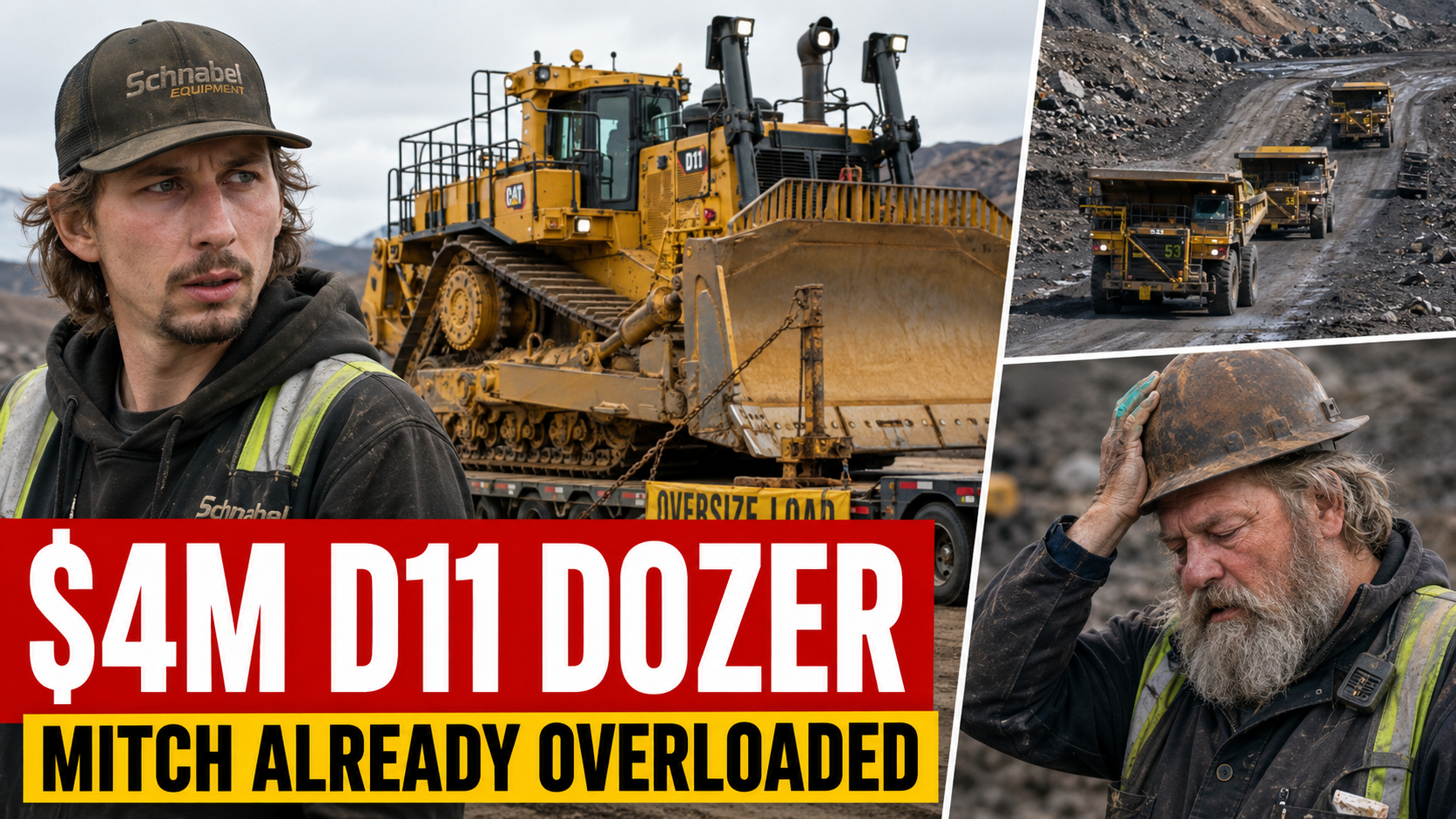
Parker Schnabel has never built his reputation by thinking small. From his earliest seasons on Gold Rush, he has treated growth as both an opportunity and an obligation. More ground requires more stripping. More stripping requires more iron. More iron requires more people, fuel, maintenance, and management. If one part of that chain falls behind, the gold can remain trapped beneath millions of dollars’ worth of equipment.
By April 17, 2026, that pressure had landed squarely on foreman Mitch Blaschke.
Mitch was already responsible for keeping the wash plant Roxanne supplied and operating as the season approached its end. He also had acres left to mine, samples to process, and muddy conditions threatening to swallow equipment. Parker then added oversight of a stripping crew preparing future ground.
His response to the workload was dramatic: a brand-new Caterpillar D11 dozer valued on the program at approximately $4 million.



To Parker, the machine represented progress. A D11 is built to move vast amounts of material and open ground on a scale smaller equipment cannot match. With the right crew and plan, it can help secure next season before the current one has even finished.
To viewers watching Mitch juggle immediate production and long-term preparation, however, the purchase raised a harder question. Can a mine solve a management bottleneck by buying a bigger machine, or does the new machine simply place more responsibility on the same exhausted people?
MITCH WAS MANAGING THE PRESENT AND THE FUTURE
A wash plant makes money only when it is fed the right material at the right rate. That simple sentence hides an enormous amount of work.
Pay dirt must be dug, hauled, and delivered. Water must flow. Tailings must be managed. Screens, belts, pumps, and other components must remain operational. Operators must watch the plant and recognize changes before they become shutdowns. Mechanics must respond when steel, hydraulics, or bearings fail.
Mitch’s immediate responsibility was Roxanne. With the season closing, every remaining acre mattered. Material left unprocessed when winter arrived could not contribute to the year’s total. The crew had to keep moving without sacrificing recovery or equipment.
At the same time, Parker was looking ahead. A successful mining business cannot wait until next season to prepare next season’s ground. Overburden—the material sitting above gold-bearing pay—must often be removed well in advance. If stripping begins too late, an expensive wash plant and full crew can sit idle while excavators and dozers struggle to expose usable ground.
That made the stripping crew essential. It also placed Mitch between two clocks.
One clock counted the remaining days of the current season. The other counted down to the next season’s start. Focusing entirely on Roxanne could leave Parker unprepared for the future. Focusing too heavily on stripping could sacrifice gold available now.
Parker’s $4 million D11 was intended to make the future clock less threatening. But a larger machine does not remove the need to coordinate people and priorities.
WHAT A D11 REALLY ADDS TO AN OPERATION
The D11 is not simply a larger version of a farm tractor. It is among Caterpillar’s biggest track-type tractors, designed for heavy dozing in mining and large earthmoving projects. Its size allows it to push material in quantities that would overwhelm smaller machines.
For Parker, that capability could change the economics of stripping. If the dozer helps expose gold-bearing ground faster, it can reduce the risk that wash plants wait for pay. It may also allow the operation to prepare larger areas, support multiple plants, and maintain the production scale Parker has pursued.
But the purchase price is only the beginning.
A machine of that size consumes fuel, wears expensive undercarriage components, requires transport planning, and depends on skilled operators and maintenance. If it is used on poor ground, the same weight and power that make it productive can create difficult recovery problems. A D11 stuck in deep mud is not rescued with a pickup truck and a tow strap.
The machine also changes workflow. Material moved by the dozer must go somewhere. Other equipment may need to load, haul, grade, drain, or follow behind it. A bottleneck downstream can reduce the value of the dozer’s production.
This is why a $4 million purchase should not be judged only by how much dirt the machine can push. It should be judged by whether the entire operation is ready to use that capacity.
MUD TURNED GROWTH INTO A RECOVERY RISK
The episode’s muddy conditions made Parker’s timing especially tense. Heavy equipment relies on stable ground, drainage, and carefully planned routes. When soil becomes saturated, traction falls and machines can sink. A dozer may be able to work where wheeled equipment cannot, but no machine is immune to bad ground.
Every stuck machine costs time. Recovery may require another dozer, excavator, cables, chains, or construction of a firmer path. The rescuing equipment can also become stuck, turning one problem into a fleet problem.
Mitch therefore had to think beyond production. He had to judge where machines could travel, whether the stripping plan remained realistic, and how to avoid placing expensive equipment in a position where it could not work.
For an experienced mechanic and foreman, that kind of judgment is part of the job. But experience does not create more hours in a day. The concern was not whether Mitch understood the work. It was whether one person could continue absorbing additional responsibility without becoming the operation’s most dangerous single point of failure.
THE HIDDEN COST OF A RELIABLE FOREMAN
Gold Rush audiences know Mitch as the person frequently called when something breaks. He combines mechanical knowledge with operational experience, and Parker trusts him with large parts of the business.
Reliable people are often rewarded with more work. A supervisor succeeds, so another project is added. He solves a breakdown, so every difficult breakdown becomes his problem. He keeps a plant running under pressure, so management assumes he can also oversee the next expansion.
That pattern is common far beyond mining. Older viewers who spent years in factories, construction firms, farms, or family businesses have seen it. The employee most capable of carrying the load becomes the person asked to carry every load.
At first, this looks efficient. The company avoids hiring another manager, and decisions remain with someone proven. Over time, however, it can create serious risk.
An overloaded foreman has less time to inspect work, coach operators, review plans, and catch small problems. He may spend the day reacting instead of preventing. Fatigue can narrow attention and shorten patience. Even when no dramatic mistake occurs, the organization becomes dependent on one person being available everywhere.
Parker’s operation has grown beyond the scale where the mine boss and one trusted foreman can personally solve every problem. The D11 purchase made that reality visible. Capital was expanding faster than human attention.
WAS THE DOZER A GIFT OR ANOTHER ASSIGNMENT?
The episode framed the D11 as welcome assistance for Mitch. That interpretation is reasonable. Better equipment can reduce strain. A powerful dozer may complete stripping work faster, operate more effectively than smaller machines, and give the crew a tool suited to Parker’s ambitious goals.
Mitch is also the kind of equipment expert likely to appreciate a new D11. For a mechanic, a capable machine is not merely an expense. It can be the difference between forcing unsuitable equipment through a job and doing the job properly.
Yet help is only help if the person receiving it has the people, authority, and time needed to use it. Otherwise, the dozer becomes another asset Mitch must schedule, protect, fuel, maintain, and explain when production falls short.
The situation resembles giving a busy shop supervisor a faster production line without adding operators or maintenance coverage. The new line may increase output, but it can also increase the number of decisions reaching the same desk.
Parker’s choice therefore sits between two truths. The D11 could relieve the physical bottleneck in stripping. It could not, by itself, relieve the management bottleneck surrounding Mitch.
PARKER’S BUSINESS PHILOSOPHY
Parker has repeatedly reinvested in land, equipment, and production capacity. His willingness to spend is one reason his operation has grown from a young miner’s risky venture into one of the franchise’s largest businesses.
Waiting can be expensive in mining. If suitable ground is available and gold prices support expansion, a cautious operator may lose years of opportunity. Equipment ordered too late may not arrive when needed. Ground left unprepared can strand an entire crew.
From that perspective, buying the D11 before the next season was a disciplined strategic move. Parker was using the current season’s strength to prepare future capacity. The machine was not purchased merely for appearance; it addressed the real need to remove overburden and open ground.
Still, expansion has a habit of making yesterday’s management structure obsolete. A small team can coordinate through direct conversation. A multi-plant operation requires clearer roles, maintenance systems, safety oversight, shift coverage, and succession when a key person is unavailable.
The better Parker’s strategy works, the more urgently he needs an organization capable of supporting it.
THE GOLD RESULTS MADE THE PRESSURE LOOK WORTHWHILE
The week’s production was substantial. Roxanne added 150.08 ounces. Tyson Lee’s Golden Mile plants produced 302.25 ounces, while Bob contributed 174.20 ounces after a hopper-chain drive problem was repaired with new sprockets following roughly four hours of downtime.
The combined results brought Parker’s operation another major gold haul and pushed the season total to 9,569.45 ounces, according to the recap.
Those figures explain why Parker continued to press forward. The operation was producing at a level where delays could represent enormous lost value, and next season’s prepared ground would be needed to sustain that scale.
But strong results can hide strain. A team that reaches its target through extraordinary effort may appear properly staffed even when the effort cannot be repeated safely or consistently. One successful cleanup does not prove that the workload is sustainable.
This is a familiar business trap. When talented employees compensate for weak systems, management sees output rather than the cost of producing it. The crisis remains invisible until the employee leaves, becomes unavailable, or finally cannot cover every gap.
The episode offered no evidence that Mitch was about to quit or that Parker’s staffing was unlawful. The phrase “at his limit” describes the visible accumulation of responsibilities, not a medical conclusion or a claim about private employment conditions. The larger concern is structural: Parker’s operation was asking one foreman to bridge immediate mining, mechanical reliability, and future expansion in difficult conditions.
WHY OLDER VIEWERS RECOGNIZE THIS STORY
The most relatable part of the D11 story may have little to do with gold.
Many Americans have watched a company buy expensive equipment while hesitating to add experienced staff. They have heard executives describe a machine as a labor-saving investment, then discovered that the machine creates new maintenance, training, scheduling, and reporting demands.
They also know the pride of being the person trusted with important work. Mitch’s responsibilities reflect Parker’s confidence in him. Being essential can be satisfying. It can also become a burden that is difficult to refuse.
The question is not whether a hardworking foreman should accept responsibility. It is whether the business has built enough depth that responsibility can be shared.
A strong operation should be able to function when its best mechanic is repairing something elsewhere. Another supervisor should understand the stripping plan. Operators should have clear priorities. Preventive maintenance should not depend on one person remembering every machine. Safety decisions should remain sound when production pressure rises.
Those systems are less dramatic than unveiling a $4 million dozer, but they may produce more value over the machine’s life.
WHAT THE PURCHASE REALLY SIGNALS
The D11 was a statement about Parker’s future. He was not preparing to shrink. He was preparing to move more ground, feed more capacity, and continue operating at a level where a single season can involve tens of millions of dollars in gold.
That confidence is one of Parker’s defining strengths. It is also the reason his next challenge will not be solved by iron alone.
The larger an operation becomes, the less success depends on the mine boss making every decision. It depends on building teams that can make good decisions without him. It depends on protecting key employees from becoming permanent emergency services. It depends on recognizing that management capacity is an asset just as real as a dozer.
Parker’s $4 million machine may prove to be an excellent investment. It may expose acres of profitable ground and help keep wash plants supplied for years. The episode did not provide enough information to calculate its final return.
What it did show was a company reaching a turning point. Parker had the capital to buy one of the world’s most powerful dozers. The more difficult task was making sure Mitch did not have to carry the weight of that growth alone.