GOLD RUSH FACES A DEEPER RECKONING: HARD-WORKING AMERICAN DREAM OR “PLUNDER” AS ENTERTAINMENT?
GOLD RUSH FACES A DEEPER RECKONING: HARD-WORKING AMERICAN DREAM OR “PLUNDER” AS ENTERTAINMENT?
For more than a decade, Gold Rush has invited viewers into a world where almost every hour carries a price tag. A broken pump can erase a day’s work. A poor test pan can put an entire season in doubt. A rich cleanup can rescue a family business. The men and women on the ground are shown working in mud, cold, noise, and danger, often far from the comforts most people take for granted.
That formula has made the Discovery franchise a durable hit, especially among viewers who admire mechanical skill, persistence, family loyalty, and the willingness to take a real financial risk. But a new wave of criticism is asking viewers to look beyond the gold totals and equipment breakdowns.
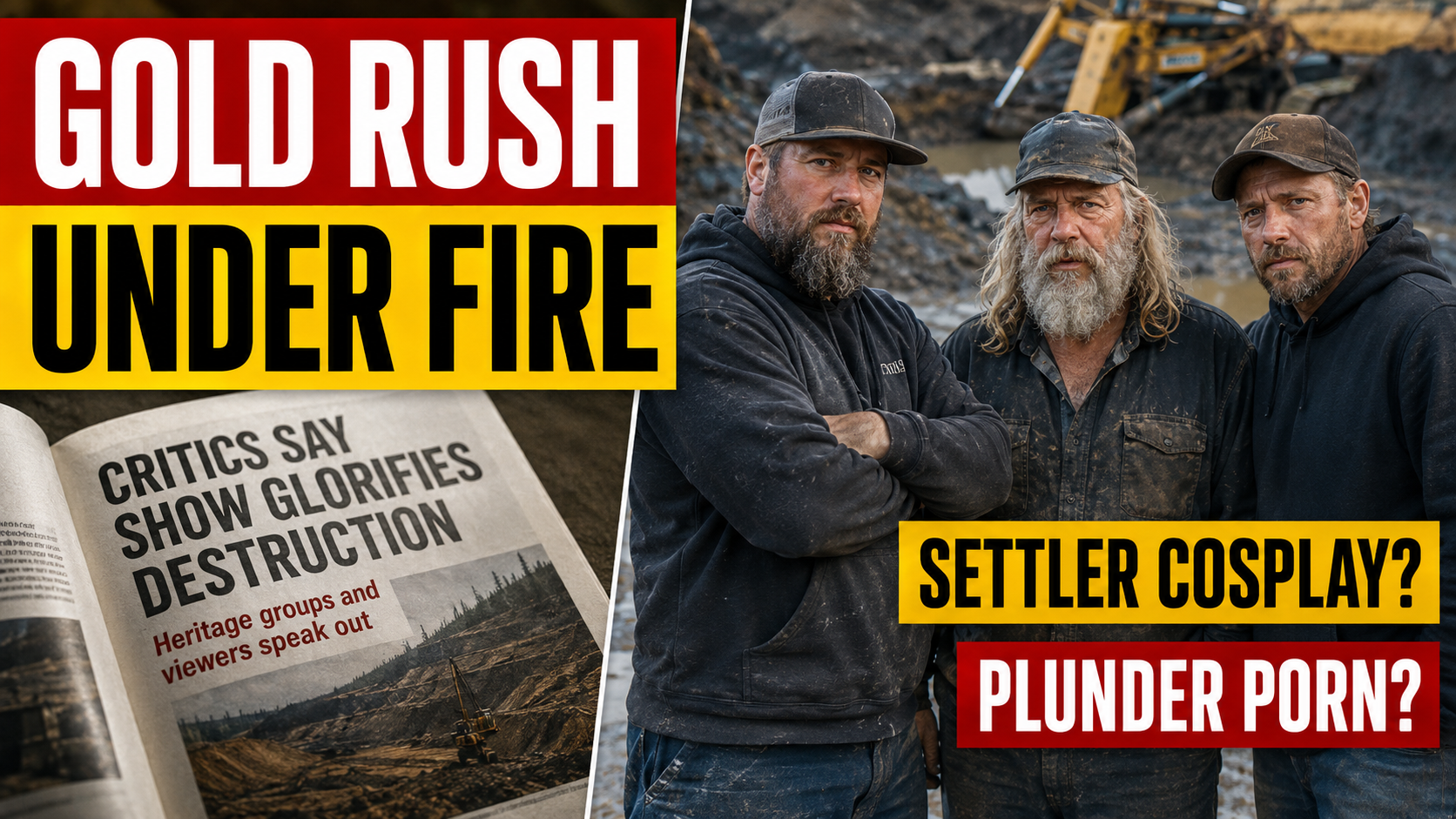
In a May 2026 New Yorker feature about America’s renewed fascination with gold, critics described Gold Rush in sharply provocative terms. Some see the series as “settler cosplay” or “plunder porn”—phrases intended to challenge the romantic image of people entering remote country, moving enormous amounts of earth, and turning natural resources into private wealth. Environmental historian Brian Leech has also placed the show within what he calls “Macho TV,” a genre centered on groups of mostly white, heterosexual men performing difficult natural-resource work in harsh conditions.
Those labels are not neutral descriptions. They are criticism, and many longtime fans will reject them. The article did not accuse Parker Schnabel, Tony Beets, Rick Ness, or another cast member of a specific new violation. Instead, it placed the entire Gold Rush brand inside a larger debate about labor, masculinity, land, environmental cost, and the stories Americans tell about resource extraction.


That distinction matters. This is not a scandal about one miner caught breaking a rule. It is a dispute over what the show celebrates—and what it leaves outside the frame.
WHY THE CRITICISM HAS LANDED NOW
Gold has never been only a metal. In American culture, it represents independence, sudden opportunity, personal courage, and escape from ordinary limits. The nineteenth-century gold rushes became part of the national mythology: a person could travel west, endure hardship, work harder than the next person, and build a new life.
That story remains powerful because it speaks to a basic American belief. Effort should matter. Skill should matter. A person willing to risk everything should have a chance to win.
Gold Rush updates that old story for television. Instead of a lone prospector with a pick and pan, viewers see excavators, rock trucks, dozers, trommels, pumps, and wash plants. The scale is industrial, but the emotional promise is familiar. Every cleanup is presented as a verdict on courage, judgment, and work.
The New Yorker’s broader argument is that gold fever has returned in several forms. Gold prices, economic anxiety, distrust of institutions, nostalgia for physical work, and social-media prospecting culture have all helped make the metal feel urgent again. In that setting, Gold Rush is more than a reality show. It becomes one of the most visible stories Americans consume about what it means to take value from the earth.
Critics argue that this story can make extraction appear cleaner and simpler than it is. Television naturally focuses on people, deadlines, machines, and dramatic reversals. Environmental review, water management, reclamation, habitat disturbance, Indigenous history, and long-term land use are harder to compress into a suspenseful episode. When those subjects receive less attention, the gold count can become the only score that seems to matter.
That is where the accusation of “plunder” enters the conversation. The critics’ concern is not merely that mining changes land; all mining does. Their concern is that the changes can be transformed into spectacle while the social and ecological consequences remain secondary.
WHY MANY FANS SEE SOMETHING COMPLETELY DIFFERENT
To millions of viewers, however, Gold Rush is not a fantasy about taking. It is a show about making.
Fans watch crews diagnose hydraulic failures in the rain, weld broken steel under pressure, rebuild equipment that would be discarded elsewhere, and coordinate complex operations where one careless decision can injure someone or destroy an expensive machine. They see workers performing jobs that require experience, nerve, and practical intelligence.
For older Americans who spent their careers in construction, farming, trucking, manufacturing, logging, mechanics, or the military, that competence is recognizable. The show’s appeal is not limited to the possibility of riches. It is also the satisfaction of watching a capable person solve a difficult physical problem.
The series also shows that gold is not simply scooped from the ground. Crews spend large amounts on fuel, labor, equipment, royalties, repairs, and preparation before knowing what they will recover. A mine boss can move thousands of yards of dirt and still lose money. A season can turn on geology, weather, access, water, permits, and mechanical reliability.
That uncertainty makes the work feel honest to viewers who have owned a small business or supported a family through unpredictable years. The numbers may be larger than most household budgets, but the pressure is familiar. Payroll arrives whether the week was good or bad. Machinery fails when it is least convenient. Pride can motivate a person, but it can also make a bad decision harder to reverse.
From that perspective, dismissing Gold Rush as “cosplay” can sound unfair. The people on screen are not wearing costumes in a studio. They are operating real equipment in real conditions, and the consequences of mistakes can be serious. Whatever a viewer thinks about mining, the labor itself is not imaginary.
THE WORD “SETTLER” CARRIES A LARGER HISTORY
The phrase “settler cosplay” is designed to provoke because it connects a modern television program to a long and painful history of expansion into Indigenous lands. The popular version of the gold-rush story often begins with adventurous newcomers and ends with towns, fortunes, and national growth. It can overlook the people who already lived on those lands, the disruption that followed, and the legal and political systems that determined who could claim resources.
Modern mining is governed by laws, permits, licenses, contracts, and environmental requirements that differ greatly from the nineteenth century. A present-day operator working under current rules is not automatically repeating every act of the historical gold rush. It would be inaccurate to collapse those situations into one simple accusation.
Still, critics argue that the old mythology survives in the way mining is presented. The central hero is often the person who arrives, overcomes nature, moves the most ground, and converts it into wealth. Land is treated mainly as an obstacle or a container of value. The deeper history of ownership, stewardship, and community can disappear behind the machinery.
For viewers, the useful question may not be whether the label is perfectly fair. It may be what the label forces the audience to notice. Who is shown as having a voice? What counts as success? What happens to the land after the gold is removed? Which costs are included in the weekly total, and which costs remain invisible?
THE ENVIRONMENTAL ISSUE IS MORE COMPLICATED THAN A SINGLE TV SHOT
Mining has environmental consequences. Placer mining, the type commonly featured in Gold Rush, involves moving sediment to separate gold. Water must be managed. Ground is disturbed. Roads and equipment affect the landscape. Poorly planned or unlawful operations can harm waterways and habitat.
At the same time, a responsible discussion should not assume that every operation shown is illegal or unmanaged. Mining jurisdictions impose requirements that can cover water use, discharge, fish habitat, land disturbance, safety, and reclamation. The exact obligations depend on location and authorization. Television episodes do not provide a full regulatory file, so viewers should be cautious about declaring a specific crew environmentally compliant—or noncompliant—based only on edited footage.
This is one reason the current debate is about storytelling as much as mining. A series can show legal, regulated work and still choose to emphasize certain values over others. It can celebrate output while giving little time to restoration. It can show a water problem as an obstacle to production without explaining the broader water system. Editing does not necessarily falsify events, but it determines which events become meaningful.
Gold Rush has occasionally included permitting trouble, water-license disputes, inspections, and reclamation concerns. Those stories can reveal that success depends on more than finding pay dirt. Yet they usually enter the show because they threaten a crew’s season. Critics want environmental and historical consequences to matter even when they do not create an immediate production crisis.
THE MASCULINITY DEBATE
The “Macho TV” description adds another layer. Gold Rush often presents a world where endurance is respected, emotional restraint is common, and personal value is tied to production. A miner proves himself by keeping the plant running, fixing the impossible breakdown, or accepting responsibility when the count falls short.
For some viewers, that is an overdue celebration of competence. American culture has spent decades moving away from many forms of manual labor, and communities built around extraction or manufacturing have often experienced job loss and declining status. A show that treats equipment operators and mechanics as central figures can feel deeply affirming.
For critics, however, the same formula can narrow the definition of strength. If worth is measured mainly by physical toughness, risk tolerance, and the ability to dominate difficult land, other forms of contribution receive less attention. Cooperation, restraint, community accountability, environmental care, and knowing when not to expand can seem less heroic than pushing one more cut before winter.
The strongest reading may be that both interpretations contain truth. Gold Rush genuinely honors forms of skill that are often ignored. It can also package those skills inside an older story about masculinity, conquest, and wealth.
WHAT THE SHOW DOES NOT OWE—AND WHAT VIEWERS CAN STILL ASK
Gold Rush is entertainment, not a university course or a regulatory hearing. Its producers build episodes around characters, conflict, danger, and payoff. Viewers tune in to see whether a crew reaches its target, not to watch hours of permit review.
But popular entertainment helps shape public understanding precisely because it reaches people who will never read an environmental assessment or a mining-history textbook. The show does not have to become a lecture for viewers to ask whether its picture is complete.
It is possible to admire Mitch Blaschke’s mechanical judgment, Tony Beets’ decades of experience, Parker Schnabel’s ambition, or the persistence of a struggling family operation while also asking harder questions about land and cost. Appreciation and criticism are not mutually exclusive.
In fact, the debate may reveal why Gold Rush remains culturally important. A forgettable program would not inspire an argument about national identity. The show touches a nerve because Americans are still divided over what progress looks like. Is it producing more with skill and determination? Is it learning to place limits on extraction? Can it be both?
THE REAL QUESTION BEHIND THE CONTROVERSY
The easiest response is to choose a side. Fans can say the critics do not respect hard work. Critics can say fans do not want to see the environmental and historical cost. Neither answer fully explains the show’s appeal or the concerns surrounding it.
Gold Rush succeeds because it turns abstract economic ideas into visible action. Capital becomes a dozer. Risk becomes a muddy haul road. Leadership becomes a decision made while a plant sits silent. Failure becomes an empty sluice box. That clarity is emotionally satisfying in a world where much work now happens behind screens and inside institutions.
Yet the land itself cannot be only a backdrop. The same camera that captures the triumph of a cleanup also records a landscape being transformed. Whether that transformation is permitted, responsibly managed, reclaimed, and socially justified cannot be answered by the gold weigh alone.
The New Yorker critique does not settle the issue. Nor should two provocative phrases substitute for evidence about any individual miner. What the criticism does is widen the frame. It asks viewers to consider not only who worked hardest and who found the most gold, but also what kind of national story is being repeated each Friday night.
For longtime fans, that does not require abandoning the series. It may simply mean watching with two ideas in mind at the same time: the work can be real and admirable, while the story built around that work can still deserve scrutiny.
Gold Rush has always asked whether the ground will pay. The more difficult question in 2026 is who gets to define the full cost.