Rick Ness’s Last-Chance Gamble Went Up in Smoke—Then the Impossible Happened
Rick Ness’s Last-Chance Gamble Went Up in Smoke—Then the Impossible Happened

THE MOMENT THE SEASON CHANGED
In the Season 16 finale, Rick tried to hedge his final-week risk by returning to Lightning Creek and
running a leftover pay pile through Rocky. He hoped that material could contribute about 50 ounces
and reduce the burden on the Last Chance Cut. Instead, Rocky began smoking when its feed pump
failed. The backup plan disappeared almost instantly, forcing the entire season to depend on the
Last Chance Cut. The sequence was dramatic because the problem arrived when the operation had almost
no useful time left. At Lightning Creek and the Last Chance Cut, the calendar was no longer
background information; it was part of the machinery. Cold weather, travel distance, crew fatigue,
and the remaining stockpile all determined whether a repair was merely inconvenient or season-
ending. The television edit concentrated those pressures into a few minutes, but the underlying
situation was straightforward: Rick Ness had committed money, labor, and reputation to a plan that
suddenly depended on solving a failed feed pump that sent smoke from the equipment.
WHY THIS WAS MORE THAN A ROUTINE BREAKDOWN
The central stakes were clear: Rick still needed roughly 400 ounces to reach his 1,800-ounce season
target, secure crew bonuses, and protect the immediate future of his operation. That context is what
transformed the event from ordinary maintenance into headline-level drama. Mining equipment fails in
every serious operation. Belts wear, bearings heat, pumps lose performance, tires split, sensors
misread conditions, and steel structures crack under repeated load. The decisive question is not
whether something breaks; it is whether the operation has enough time, redundancy, parts, people,
and prepared ground to absorb the interruption. In this case, the answer was uncertain because the
Rocky wash plant occupied a critical point in the production chain.
WHAT ACTUALLY HAPPENED
In the Season 16 finale, Rick tried to hedge his final-week risk by returning to Lightning Creek and
running a leftover pay pile through Rocky. He hoped that material could contribute about 50 ounces
and reduce the burden on the Last Chance Cut. Instead, Rocky began smoking when its feed pump
failed. The backup plan disappeared almost instantly, forcing the entire season to depend on the
Last Chance Cut. No evidence suggests a criminal scandal or hidden misconduct. The word “scandal” is
being used here in the loose reality-TV sense: a public, high-pressure episode that generated
controversy, debate, and dramatic headlines among viewers. That distinction matters. A strong
headline can emphasize the danger and cost without inventing accusations. The facts are already
compelling because the failure exposed how quickly a multi-million-dollar mining plan can be reduced
to one unavailable part, one empty stockpile, one damaged truck, or one difficult judgment call.
THE MACHINERY BEHIND THE DRAMA
A wash plant is only productive when every supporting system works together. The feed system must
move material at a controlled rate, water must carry the classified material through recovery
equipment, and pumps must maintain the flow that keeps the plant processing. When a feed pump fails,
the plant can no longer receive or circulate material correctly, and continuing to operate may cause
additional damage. Smoke turns a mechanical warning into an immediate shutdown signal. This
interconnected design explains why a single failure can stop equipment that appears unrelated. A
plant may be ready while its trucks are not; an excavator may be digging while no safe route exists
to haul material; a pump may be intact while an electronic control refuses to authorize startup. On
television, the failed component becomes the visual symbol of the crisis. In operational terms,
however, the real problem is the broken link between excavation, transport, processing, recovery,
and cleanup.

THE COST OF AN IDLE HOUR
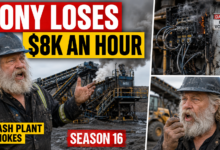
Gold mining converts time into both opportunity and expense. Fuel, payroll, rentals, financing,
maintenance, catering, camp operations, and support vehicles continue to cost money even when no
gold reaches the recovery system. Late in a season, lost hours can become more expensive because
there may be no future week available to recover them. A shutdown also creates secondary losses:
excavators wait for trucks, loaders wait for plant capacity, mechanics leave preventive work to
handle emergencies, and supervisors redirect crews from planned tasks. For Rick Ness, the immediate
incident therefore threatened more than the repair bill. It threatened the production sequence built
around the Rocky wash plant.
LEADERSHIP UNDER A VISIBLE DEADLINE
Reality television places the mine boss at the center of every decision, but leadership in these
moments is distributed. Rick Ness sets priorities and accepts financial risk, while foremen
coordinate the site, operators protect equipment, mechanics diagnose failure, and support staff
locate parts or reorganize material flow. A strong response requires speed without panic. Move too
slowly and the weather or stockpile wins. Move too quickly and a temporary problem can become a
damaged machine or an injured worker. The episode’s tension came from watching the team make those
decisions publicly, with the audience aware that the remaining margin was measured in hours and
ounces.
THE HUMAN COST BEHIND THE GOLD TOTAL
Rick’s small crew had already endured a season defined by delays, expensive decisions, uncertain
ground, and repeated restarts. Brian “Zee” Zaremba worked through his final night before leaving to
return to his family, while the rest of the crew faced the possibility that months of labor might
end without the bonuses they had been chasing. The pressure involved loyalty, jobs, and whether the
team could plausibly return. Production targets are presented as clean numbers, yet the work is
performed by people inside noisy, muddy, cold, and mechanically unforgiving environments. Fatigue
can narrow attention. Repeated setbacks can damage morale. Family commitments continue beyond the
mine gate, and a season’s result may determine whether workers return the following year. The most
effective Gold Rush episodes reveal that tension without needing to manufacture a villain. The
pressure comes from the operation itself: nature does not extend a winter deadline because a crew
has already worked a long shift.
WHY VIEWERS CALLED IT A CRISIS
Fans often judge these episodes through two competing ideas. One side sees bold leadership: use
every available asset, improvise, push until the last yard is washed, and refuse to accept an
avoidable shutdown. The other side sees an operation running too close to the limit: insufficient
redundancy, exhausted workers, deferred maintenance, or a target so aggressive that ordinary
failures become emergencies. The incident involving the Rocky wash plant supports both readings. The
response demonstrated capability, but the scale of the consequences also showed how dependent the
season had become on a narrow plan.
REALITY TELEVISION VERSUS OPERATIONAL REALITY
Gold Rush is edited entertainment, not a continuous engineering record. Viewers see selected
conversations, repairs, weigh-ins, and reactions arranged into a narrative. That means the program
may compress the diagnosis, omit routine inspections, or emphasize uncertainty even when the crew
has several options. Responsible coverage should therefore separate what the episode directly
reported from broader interpretation. The verified core is that a failed feed pump that sent smoke
from the equipment affected the operation at Lightning Creek and the Last Chance Cut. The larger
claims—whether the plan was reckless, heroic, preventable, or inevitable—are interpretations that
viewers may reasonably debate.
THE STRATEGIC ASSUMPTION THE EPISODE EXPOSED
Every late-season crisis reveals a planning assumption. Sometimes the assumption is that one machine
will remain available. Sometimes it is that prepared pay will last until the next cut opens, that a
supplier will have a part, or that a small fleet can tolerate losing one vehicle. Here, the event
exposed the operation’s dependence on the Rocky wash plant. That does not automatically prove poor
management. Mining businesses often choose concentration because duplicate equipment is extremely
expensive. But concentration creates a single point of failure, and the closer the deadline becomes,
the more valuable redundancy appears.
WHAT A MORE CONSERVATIVE OPERATION MIGHT DO
A conservative response would include larger parts inventories, backup pumps or trucks, additional
prepared stockpiles, more preventive inspection, and production targets with greater schedule
contingency. Those measures reduce drama but require capital, storage, transport, and labor. A spare
component that never fails may look like wasted money; after a shutdown, the same component looks
essential. This is the central economic tension of remote mining. The operation must decide which
risks to insure physically with spare assets and which risks to accept because carrying full
redundancy would make the project uneconomic.
WHY THE AGGRESSIVE STRATEGY CAN STILL WORK
Aggressive operators gain when speed converts a limited season into more processed yardage. Once the
fixed costs of camp, equipment, and access are committed, additional productive hours can generate
substantial value. That logic encourages crews to repair in the field, fly parts, move plants,
reopen old stockpiles, or work overlapping shifts. The strategy succeeds when experience and
coordination keep the operation inside safe limits. In this case, the crew did not simply complain
about a failed feed pump that sent smoke from the equipment; it reorganized around the problem and
attempted to preserve the season’s objective.
THE OUTCOME
The Last Chance Cut delivered 431.91 ounces in the final weigh-in. Rick finished at 1,811.56 ounces,
narrowly clearing the 1,800-ounce goal. The result secured the crew’s bonuses and gave the operation
a credible path forward. The failure of Rocky therefore became the episode’s final false ending: the
machine crisis looked fatal, but the remaining cut produced enough gold to reverse the story. The
verified result is important because it prevents the story from becoming misleading disaster
content. The crisis was real, but it was not necessarily the end of the operation. Rick finished
Season 16 with 1,811.56 ounces, exceeding his 1,800-ounce target by 11.56 ounces. That conclusion
does not erase the risk or cost of the incident. Instead, it demonstrates why the sequence was
compelling: the audience saw a plausible failure state, followed by a response whose success was
uncertain until the final production figures were known.
WHAT THE INCIDENT SAYS ABOUT SEASON 16
Season 16 repeatedly presented scale as both advantage and vulnerability. Bigger goals justified
more plants, more ground, more machinery, and more complex logistics. At the same time, every added
system created another component that could fail. The leading operations produced extraordinary
totals, but their success was not smooth. It depended on mechanics, operators, foremen, pilots,
fabricators, partners, and family members solving problems faster than winter could close the mines.
The episode involving Rick Ness condensed that theme into a single storyline: ambition created the
opportunity, and operational fragility created the suspense.
THE PUBLIC-RELATIONS LESSON
For a public figure on a reality series, the response to failure can matter as much as the failure
itself. Audiences tend to forgive broken machinery because breakdowns are expected. They judge
whether the boss accepts responsibility, communicates clearly, protects the crew, and chooses a
solution proportionate to the risk. A dramatic headline may attract attention, but the lasting
impression comes from competence under pressure. Rick Ness emerged from this incident with a story
that could be framed as desperation or resilience, depending on which part of the sequence a viewer
emphasizes.
WHY THE HEADLINE IS FAIR—BUT NEEDS CONTEXT
The title emphasizes the most dramatic verified element: a failed feed pump that sent smoke from the
equipment. It does not mean the entire operation collapsed, that anyone committed misconduct, or
that the equipment was permanently destroyed. A fair article must deliver the context behind the
headline: the timing, the production target, the technical dependency, the crew’s response, and the
eventual result. Without those elements, clickbait becomes distortion. With them, a strong headline
functions as an invitation into a genuinely high-stakes operational story.
WHAT COMES NEXT
The lasting consequence of a late-season emergency is often carried into the next planning cycle.
Crews review which components failed, which parts were difficult to obtain, how long recovery took,
and whether the production plan depended too heavily on one route or one machine. The mine boss then
decides whether to purchase spares, change maintenance intervals, widen the fleet, prepare more
stockpile, or accept the same exposure in exchange for lower costs. For Rick Ness, the episode
provided a clear operational case study involving the Rocky wash plant and the limits of a schedule
with almost no slack.
FINAL ASSESSMENT
This was one of Season 16’s strongest examples of how quickly a mining plan can change. Rick Ness
entered the sequence with a defined production strategy, but a failed feed pump that sent smoke from
the equipment forced the crew to improvise under a shrinking deadline. The incident was not a legal
scandal; it was a public test of preparation, leadership, mechanical skill, and risk tolerance. The
outcome showed that a crisis can expose weaknesses without automatically producing failure. For
viewers, that uncertainty is the real attraction of Gold Rush: the gold total is important, but the
route to that number is where the story lives.