GOLD RUSH WILDFIRE CRISIS: PARKER SCHNABEL KEEPS MINING AS FLAMES CLOSE IN—IS HE GAMBLING WITH HIS CREW’S LIVES?
GOLD RUSH WILDFIRE CRISIS: PARKER SCHNABEL KEEPS MINING AS FLAMES CLOSE IN—IS HE GAMBLING WITH HIS CREW'S LIVES?
What Happened at Dominion Creek?
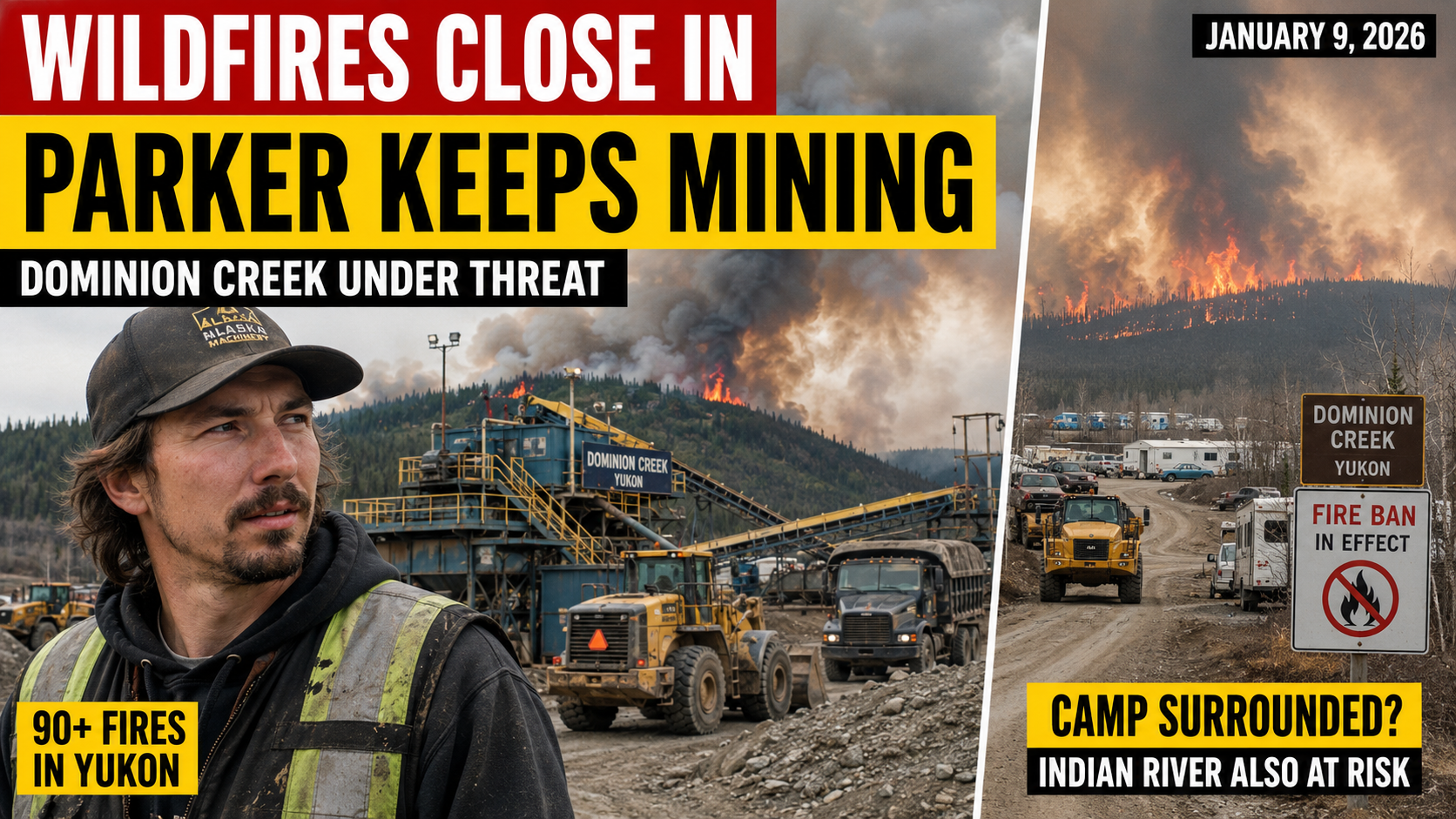
The Yukon wilderness has always been an adversary, but this season it brought a new and terrifying weapon: fire. During the January 9 episode of Gold Rush, the miners faced a threat unlike any they had encountered before. More than 90 wildfires, believed to have been sparked by lightning, were tearing across the territory, consuming approximately 250,000 acres of forest and brush. At Dominion Creek, the flames had moved to within three or four miles of Parker Schnabel’s camp—close enough that the smoke was visible on the horizon and the smell of burning timber filled the air.
Parker was inching toward 3,000 ounces for Season 16, a solid foundation for his ambitious 10,000-ounce goal. But the wildfires presented a threat that no amount of planning or mechanical ingenuity could overcome. A single shift in the wind, a sudden flare-up, and the operation could be cut off entirely—with no way in and no way out.

Why Did Parker Keep Mining Despite the Danger?
The question on every viewer’s mind was simple: why didn’t Parker evacuate? The answer, as with most decisions in the high-stakes world of gold mining, is complicated. Parker’s operation at Dominion Creek was running at full capacity, with multiple wash plants processing paydirt around the clock. Every hour of production was critical to reaching the season goal, and shutting down meant abandoning thousands of ounces of potential gold.
But there was also a more practical consideration. The fires, while dangerously close, had not yet reached the point where evacuation was mandatory. Parker made the calculation that his crew could continue operating as long as the immediate path to safety remained open. It was a gamble, but one that he felt was justified by the circumstances.
“The worst thing that could happen is the roads are engulfed in flames,” Parker told his foreman, Mitch Blaschke. It was a stark admission that the situation was precarious, but it was also a recognition that the threat was not yet imminent. For Parker, the decision to continue mining was not recklessness—it was a calculated risk based on the information available.
How Close Did the Fire Actually Get?
The proximity of the flames was alarming by any standard. At Dominion Creek, the fires had advanced to within three or four miles of camp. In wildfire terms, that is dangerously close—close enough that embers carried by the wind could ignite equipment or structures, and close enough that an evacuation would require immediate action.
For Tony Beets at Indian River, the situation was equally tense. The fires were approximately two miles from his operation, yet Tony showed no signs of slowing down. The “King of the Klondike” was undeterred, focused on building generational wealth and maintaining his momentum in the season’s gold race. The contrast between the two miners was striking: both faced the same threat, both acknowledged the danger, and both chose to keep digging.
The question of whether this was bravery or foolishness depends largely on perspective. Parker and Tony are both experienced operators who have navigated countless dangers in their careers. They trust their judgment and believe they can recognize when a situation has become genuinely life-threatening. But the wildfires represented a force of nature that is notoriously unpredictable—and even the most experienced miner can be caught off guard.
Did Parker Have a Contingency Plan?
Parker’s approach to the wildfire threat was not simply to ignore it and hope for the best. He was working on a specific timeline: foreman Mitch Blaschke needed two weeks to finish sluicing the stockpile pay at Sulphur Creek before the water license expired. Parker had to leave for five days, which was the window Mitch estimated he needed to complete the work and move the wash plant Roxanne 25 miles to Ken and Stuart’s claim.
The plan was tight but achievable—provided the fires did not intervene. Parker’s strategy was to push through the immediate threat while maintaining awareness of escape routes and emergency protocols. It was a high-wire act that required constant monitoring of the fire’s progress and a willingness to abandon the operation at a moment’s notice.
The fact that rain eventually helped extinguish the blazes was a stroke of luck that Parker could not have counted on. Had the weather not cooperated, the outcome could have been very different. The operation was saved not by Parker’s planning but by forces beyond his control—a reminder that in the Yukon, even the best-laid plans are subject to the whims of nature.
What Happened to Tony Beets During the Fires?
While Parker was racing against the flames at Dominion Creek, Tony Beets was dealing with his own crisis at Indian River. The wildfires were two miles away, but Tony’s immediate concern was closer to home: his wash plant Sluice-A-Lot had started smoking and had to be shut down.
The problem turned out to be a burnt-out wiring harness and an overheated motor. The crew replaced the 600-pound motor, but the plant remained inoperable. Stumped, Tony called in an electrician, who determined that a generator was needed to get the equipment running again.
The downtime was expensive. Every hour without gold production cost Tony approximately $8,000. When the plant finally ran for two days and two nights, it brought in 121.10 ounces worth $420,000. It was a decent haul, but not enough to offset the lost production time. Meanwhile, Mike Beets’ operation at Paradise Hill generated 36.88 ounces over five days—a result that Tony found disappointing.
The juxtaposition of the wildfire threat and the equipment breakdown highlighted the multiple fronts on which Tony was fighting. The fires were a distant but real danger; the mechanical failure was an immediate crisis. Managing both simultaneously required the kind of focus and resilience that has defined Tony’s career.
What Was Rick Ness Doing During the Crisis?
While Parker and Tony were grappling with wildfires and breakdowns, Rick Ness was facing his own set of challenges. He wanted to deliver at Lightning Creek, but his crew was questioning his decision not to move immediately to Duncan Creek after the water license was renewed.
Rick had already invested significant money and time in Lightning Creek. He owed 100 ounces to buy the claim outright, even though it had only netted him 29 ounces so far. The math was not working in his favor, and his crew was losing patience. The wildfires added another layer of uncertainty to an already precarious situation.
Unlike Parker and Tony, Rick was not operating in the immediate path of the flames. But the broader threat of the fires—the potential for road closures, supply disruptions, and emergency evacuations—hung over his operation as well. The wildfires were a reminder that in the Yukon, no one is truly safe from the forces of nature.
Is There a Pattern of Risk-Taking Among the Miners?
The decision to continue mining despite the wildfire threat is consistent with a pattern of risk-taking that has defined Gold Rush from the beginning. The miners are not casual operators; they are individuals who have staked their fortunes—and in some cases, their lives—on the pursuit of gold.
Parker Schnabel, in particular, has built his career on bold decisions. From investing in expensive new equipment to pushing his crew to the limit, he has consistently chosen the path of maximum effort and maximum reward. The wildfire crisis was simply another example of this approach.
But the pattern also raises uncomfortable questions. At what point does boldness become recklessness? When does the pursuit of gold cross the line from ambition to endangerment? The wildfires were a force of nature that Parker could not control, and his decision to keep mining while they approached was a gamble that could have ended in tragedy.
The fact that it did not—thanks to the timely arrival of rain—does not necessarily mean it was the right decision. It means that Parker got lucky. And in the mining world, luck is a poor substitute for good judgment.
What Are Fans Saying About the Wildfire Episode?
The reaction from the Gold Rush fan community has been intense. Some viewers have praised Parker and Tony for their determination, arguing that the show is about pushing boundaries and taking risks. Others have expressed concern that the miners are prioritizing gold over safety, putting their crews at unnecessary risk.
The debate reflects a broader tension in the show’s appeal. Gold Rush is entertainment, but the dangers are real. When viewers watch Parker continue mining as fires close in, they are witnessing a genuine crisis, not a scripted drama. The stakes are high, and the consequences of a wrong decision could be fatal.
Some fans have also questioned whether the network and production company have a responsibility to intervene when safety is at risk. Should Discovery have ordered an evacuation? Should the miners have been required to shut down? These are difficult questions with no easy answers.
What Does the Future Hold for Mining in Fire-Prone Areas?
The wildfires that threatened Dominion Creek and Indian River are part of a broader trend. As climate change intensifies, wildfire seasons are becoming longer and more severe. The Yukon, like much of the Canadian north, is increasingly vulnerable to large-scale fires that can threaten communities and industries alike.
For miners like Parker and Tony, this means that wildfires will become an ever-present risk. The days of assuming that fire season is a manageable inconvenience are over. The new reality is one of constant vigilance, where the threat of fire is as much a part of the mining equation as equipment breakdowns and ground conditions.
The challenge for the miners is to adapt. This may mean investing in fire prevention measures, developing more robust evacuation plans, and being willing to shut down operations sooner rather than later. It may also mean accepting that some seasons will be lost to fire—and that the pursuit of gold must sometimes yield to the need for safety.
The Bottom Line
The wildfire crisis that threatened Parker Schnabel’s operation at Dominion Creek was one of the most dramatic moments of the season. More than 90 fires burning across 250,000 acres, flames within three or four miles of camp, and a mining prodigy who refused to stop digging.
Parker’s decision to continue mining was a calculated risk—one that paid off thanks to the timely arrival of rain. But it was also a gamble that could have ended very differently. The fires were a reminder that in the Yukon, nature is the ultimate authority, and no amount of determination can guarantee safety.
Tony Beets faced the same threat at Indian River, adding equipment breakdowns to the chaos. Rick Ness, meanwhile, struggled with his own challenges, his crew questioning his decisions as the fires burned in the distance.
The episode raised difficult questions about risk, responsibility, and the limits of ambition. For the miners, the answer was clear: keep digging, keep pushing, and hope that the flames stay away. Whether that answer was the right one is a question that each viewer must answer for themselves.
As the season continues, the threat of fire will remain a constant presence. The miners have been warned, and they have been lucky. But luck, as every miner knows, is a finite resource.