THE RISE, FALL, AND REDEMPTION OF RICK NESS: GOLD RUSH STAR OPENS UP ABOUT MOTHER’S DEATH, CRIPPLING DEPRESSION, SUBSTANCE ABUSE, AND FINANCIAL RUIN
THE RISE, FALL, AND REDEMPTION OF RICK NESS: GOLD RUSH STAR OPENS UP ABOUT MOTHER’S DEATH, CRIPPLING DEPRESSION, SUBSTANCE ABUSE, AND FINANCIAL RUIN
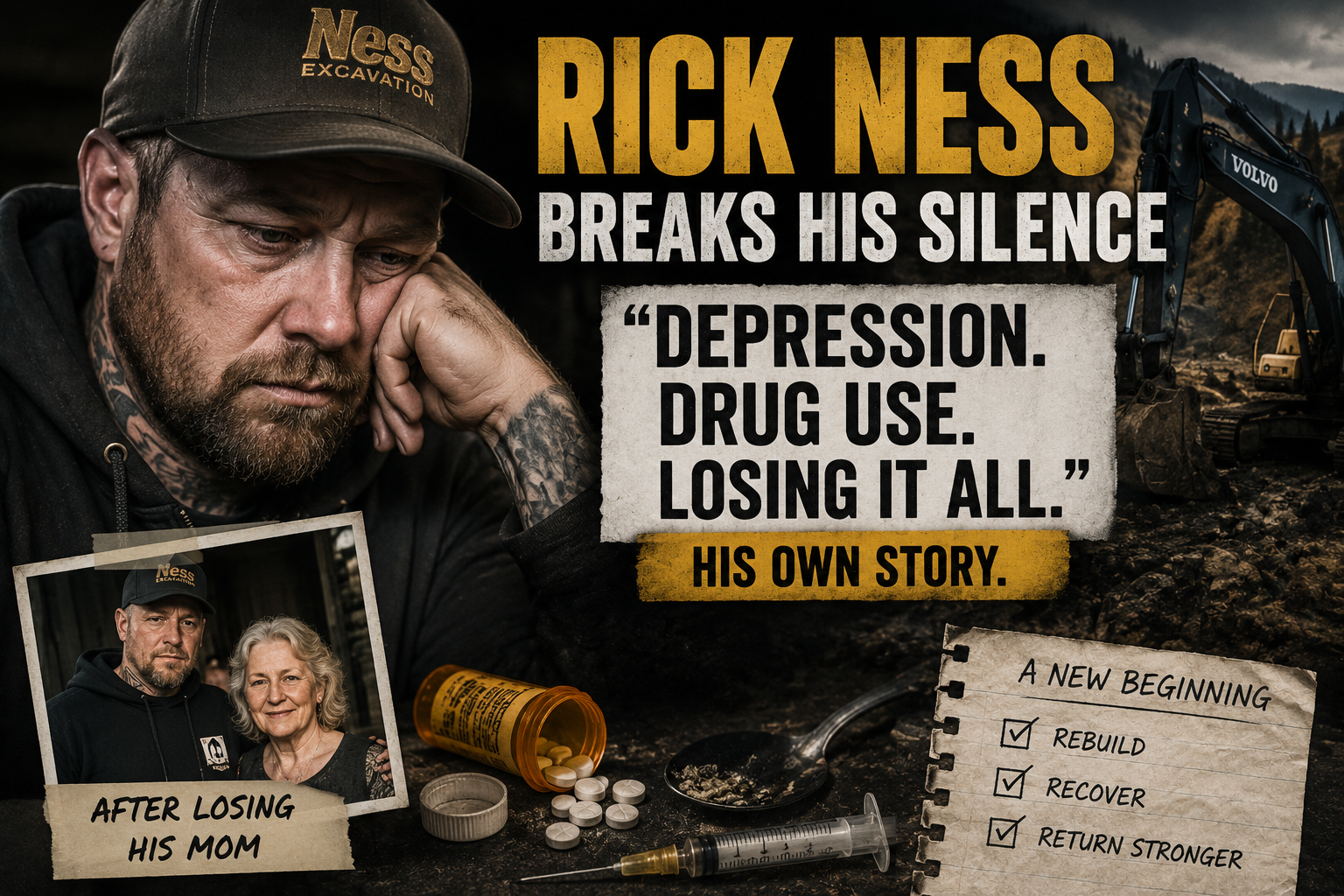
The Golden Boy of the Klondike
For over a decade, viewers of Discovery Channel’s colossal hit Gold Rush have watched Rick Ness transform from a rugged, long-haired musician into one of the most formidable heavy-equipment operators in the placer mining industry. He was the man who left the comfort of Parker Schnabel’s crew to strike out on his own, a gamble that paid off handsomely as he secured his own ground and proved he had the Midas touch. With his barrel chest, booming laugh, and an almost reckless work ethic, Ness embodied the indomitable spirit of the modern-day prospector. He was the everyman who made good, a symbol of relentless perseverance against the unforgiving Yukon wilderness. However, the reality behind the television edit is often far grittier than the mechanical breakdowns and gold weigh-ins that fans have come to love. In a stunning and deeply vulnerable public admission that has sent shockwaves through the reality television community, Ness has laid bare the harrowing truth of his life away from the cameras—a truth involving profound mental illness, debilitating substance abuse, and a financial collapse so severe that he finds himself starting from scratch after more than a decade of back-breaking labor. The revelation strips away the final layer of television polish, revealing a man who did not just battle the permafrost but also the darkest recesses of his own mind.
The Tragic Turning Point: Losing His Anchor
The narrative of Rick Ness’s life took a seismic and tragic turn with the passing of his mother, a woman he has consistently described as his rock and his primary source of emotional stability. The grief that followed was not a fleeting shadow but a suffocating shroud that descended upon him with an almost physical weight. In his candid confession, Ness described a descent into a clinical depression so acute that he no longer recognized the person staring back at him in the mirror. The man who had once commanded a crew of dozens with a booming voice and an iron will found himself unable to perform the most basic tasks of daily life. It was a paralysis of the soul, where the drive to get out of bed and face the world evaporated, replaced by an overwhelming sense of apathy and existential dread. This was not merely sadness; it was a chemical and emotional abyss that swallowed his motivation whole. He spoke of waking up in the morning with a chest so heavy it felt as though he were drowning in air, a sensation that made the physical strain of mining seem like a pleasant memory. The very qualities that made him a star—his tenacity and his refusal to quit—seemed to abandon him at the exact moment he needed them most.




Self-Isolation: The Long Walk into Darkness
As the depression tightened its icy grip, Ness began to implement a coping mechanism that would ultimately prove to be more destructive than the grief itself: he started to isolate. The self-imposed exile was a gradual process, a slow retreat from the world that began with ignoring phone calls and ended with him becoming a ghost to those who loved him most. The social butterfly of the mining camps, known for sharing a beer and a story with the crew after a long shift, became a recluse. He described a period of intense loneliness, yet paradoxically, he craved that solitude because it was the only environment where he didn’t have to pretend to be okay. He shut out his friends, his remaining family, and even his business partners, effectively severing the lifelines that could have pulled him back from the brink. This isolation was not born of malice but of a deep-seated shame; he felt that he had failed his mother by not being able to save her, and he couldn’t bear to let anyone else see the man he had become. The vibrant world of Gold Rush continued to spin, with cameras rolling and crews mining, but Ness was stuck in a time capsule of grief, watching the world from behind a pane of glass he couldn’t break. His absence from the show during the pivotal mining seasons was not a strategic career move, as fans had speculated, but a desperate act of survival. He was hiding, hoping that if he retreated far enough, the pain would eventually lose his trail.
Substance Abuse: Numbing the Unbearable
In a desperate bid to silence the relentless noise of his own thoughts, Rick Ness turned to the false solace of drugs. He openly admitted that he resorted to substance abuse as a blunt instrument to “numb the feelings,” a chemical lobotomy to escape the reality of his loss. This was not recreational indulgence; it was a form of self-medication, a dangerous, spiraling attempt to find a pause button for his relentless grief. The substances acted as a temporary anesthetic, offering fleeting moments of peace that stood in stark contrast to the chaotic agony of his sober state. However, as is the insidious nature of addiction, the tolerance built, and the relief became ever more fleeting, requiring greater quantities and riskier behaviors to achieve the same effect. While he did not immediately specify the exact cocktail of substances in his initial admission, the implication was clear: the drugs took hold of his life, transforming him from a disciplined businessman into a passenger in his own body, along for a ride he no longer controlled. The man who prided himself on his sharp instincts in the cutthroat world of mining negotiations was now making decisions under a clouded judgment that he himself admits he would have ridiculed in his younger days. It was a classic, tragic case of the cure being worse than the disease, as the drugs did not heal the wound of his mother’s death; they simply kept it infected, preventing the scar tissue of time from forming. The clarity that had built his mining empire was replaced by a mental fog, and the strategic mind that navigated the treacherous landscape of the gold market was reduced to a single, all-consuming priority: finding the next hit to make it through the night.
Financial Ruin: A Decade of Sweat Evaporated
The convergence of profound depression and relentless substance abuse created a perfect storm of poor decision-making that would eventually bleed Rick Ness dry—financially and professionally. Over a decade spent drilling, blasting, and sluicing for gold had amassed a significant fortune, a financial safety net that he had built with his own two hands. Yet, in the throes of his mental and chemical turmoil, he watched that empire crumble. He admitted to making “bad decision after bad decision,” each one more catastrophic than the last. While he hasn’t detailed every financial misstep, the results are painfully evident. Money that should have been reinvested into heavy machinery, fuel, and payroll for a competitive crew was seemingly mishandled. Deals that would have secured prime mining claims were lost. At a time when he should have been focused on the logistics of yardage and the purity of the paydirt, his mind was consumed by grief, leading to oversight, negligence, and a series of operational failures that drained his accounts. It is a staggering reality: the money he had earned over more than ten years of grueling labor, enduring sub-zero temperatures, mechanical failures, and the constant threat of injury, essentially evaporated. He went from standing atop the gold-rich soil of the Yukon to staring at an empty bank balance, left to reckon with the devastating realization that he had no wealth to fall back on and no solid ground to stand on. The security he had spent his adult life building was gone, scattered to the winds of his destructive habits and his inability to focus on the business at hand.
The Road to Rebuilding: Starting from Ground Zero
Facing this utter desolation—a soul hollowed out by grief, a body ravaged by drugs, and a bank account that had flatlined—Rick Ness was confronted with the ultimate question that defines a human being: is this the end, or is this the start of a new beginning? To his immense credit, he chose the latter, though it required a level of humility and raw honesty that few in the public eye are capable of mustering. The first step was the confession itself, a public admission that served as both a catharsis and a declaration of intent. He has spoken about the grueling process of rehabilitation, of getting clean and facing the emotional pain he had tried so hard to bury. It involved tearing down the walls of isolation he had so carefully constructed and reconnecting with the support system he had abandoned. He had to look his remaining crew in the eye and admit that he had led them down a path of ruin, a conversation that must have been one of the hardest moments of his life. But from the ashes of that fall, a new Rick Ness is emerging—one who is more reflective, more cautious, and fiercely determined to reclaim his narrative. His journey back to the small screen is not just a television plotline; it is a testament to the human capacity for resilience. He is currently working on a comeback, attempting to secure new claims and scrape together the resources to get back into the gold game, effectively starting his career over from a position far worse than where he began a decade ago.
The Gold Rush Community Responds
The reaction from the Gold Rush community has been one of profound sympathy and shock, mixed with a resounding wave of support. Industry titans like Tony Beets and his former boss, Parker Schnabel, have publicly expressed their shock at the severity of Ness’s struggles, while privately sending messages of encouragement. The mining world is notoriously tough, often equating vulnerability with weakness, but Ness’s honesty has shattered that stereotype, sparking a crucial conversation about mental health within the high-stakes environment of resource extraction. In an industry where men are often expected to be unbreakable, his admission has served as a powerful reminder that the human psyche can buckle under immense pressure, regardless of how strong the exterior appears. Fans have flooded social media with messages of hope, grateful that he survived the depths of his addiction to tell the tale, rather than becoming another grim statistic of the opioid or mental health crises that plague North America. The show’s producers are reportedly documenting this comeback, understanding that this raw, authentic human struggle is far more compelling than any gold weigh-in could ever be. They are not just filming a miner; they are filming a survivor, and that narrative carries a weight and gravity that appeals to millions who have faced their own private battles in the dark.
A New Chapter: More Than Just Gold
Rick Ness’s story is a stark cautionary tale about the hidden costs of fame and fortune, but it is also an inspiring blueprint for redemption. It highlights the terrifying speed with which a person can lose everything when mental health is neglected and substance abuse takes the wheel. His transparency about the loss of his mother, his subsequent slide into self-destruction, and his financial ruin serves as a beacon of hope for others suffering in silence. By admitting that he cried alone, that he spent his money recklessly, and that he sought refuge in the temporary comfort of drugs, he has humanized himself in a way that transcends his television persona. He is no longer just “Rick the Miner”; he is a son mourning his mother, a man battling his demons, and a fighter crawling his way back to the surface. The gold is still out there in the Yukon soil, but now Rick Ness is digging for something far more precious: his own sanity, his sobriety, and his self-respect. It is a minefield that requires even more courage and grit than the frozen tundra of Canada. As he forges ahead, building his new identity from the ruins of his old life, the world will be watching. For Rick, the true gold rush is no longer about the glittering metal; it is about the unshakeable realization that as long as he is clean and breathing, he has not lost everything. And that, perhaps, is the most valuable claim of all.